


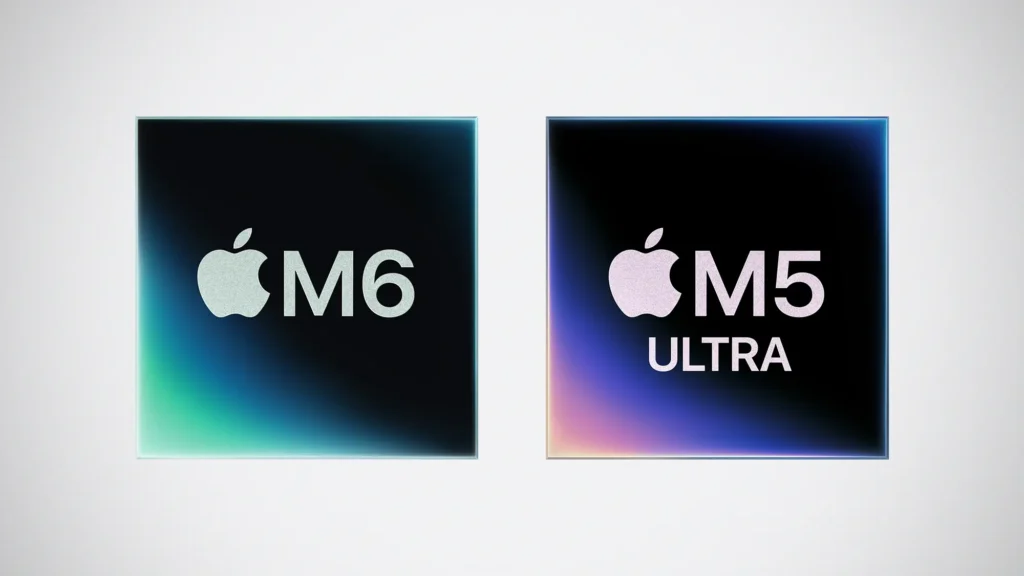
Apple’s M5 had barely warmed the silicon seat, and already the M6 is here to ask it to scoot over. Joining it is the M5 Ultra, a processor so excessive that Apple apparently needed four dies just to contain its ambitions.
The M6 is Apple’s first chip built using a 2 nm process. It packs a new 12-core CPU comprising two super cores, four performance cores, and six efficiency cores, delivering up to 1.2x faster multithreaded performance than the M5. There is also a 12-core GPU with a Neural Accelerator in every core, bringing nearly 30 percent more peak GPU compute for AI.
As if one Neural Engine were no longer fashionable, the M6 has two 16-core Neural Engines, offering up to twice the peak compute of previous generations. It supports up to 32 GB of unified memory and 170 GB/s of bandwidth, allowing on-device AI models, creative apps, and your neglected browser tabs to coexist peacefully.
Then there is the M5 Ultra, Apple’s new silicon heavyweight. UltraFusion connects two dual-die M5 Max chips, creating Apple’s first quad-die architecture. The result is up to a 36-core CPU, an 80-core GPU, and 1.2 TB/s of unified memory bandwidth.
It also supports up to 512 GB of unified memory, enough to run enormous AI models with hundreds of billions of parameters locally. Or Chrome with several tabs open. Your call.
The M6 powers the new Mac mini, while the M5 Ultra resides in the new Mac Studio, presumably plotting the financial demise of creative professionals. But more on both machines in separate stories.
Specs highlight are as follows: M6—12-core CPU, 12-core GPU, Dual 16-core Neural Engine, up to 32 GB unified memory, and 170 GB/s memory bandwidth. M5 Ultra—up to 36-core CPU, 80-core GPU, 32-core Neural Engine, 512 GB unified memory, and 1.2 TB/s memory bandwidth.
Images: Apple.