


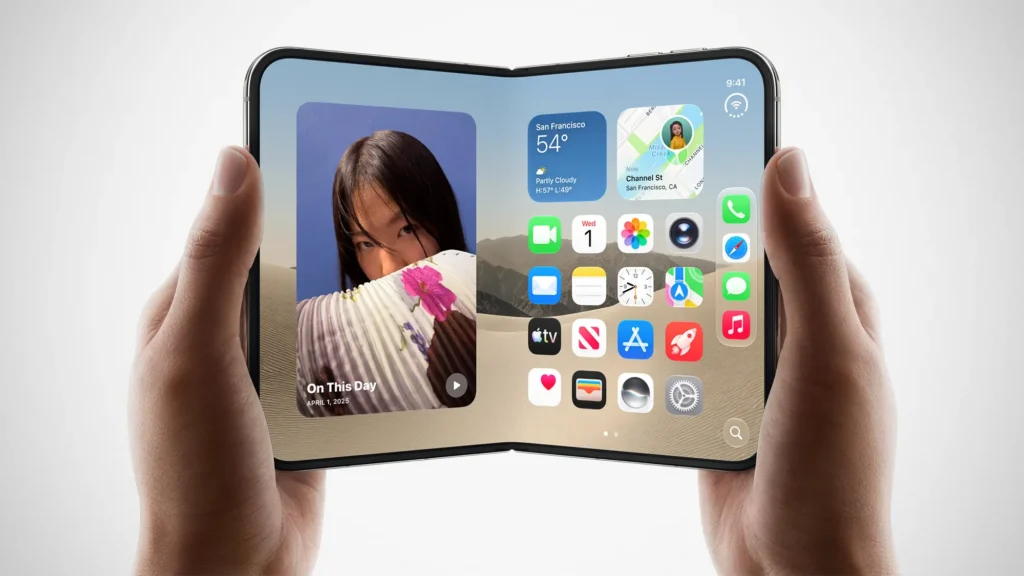
If you haven’t already heard, Apple’s long-awaited folding phone has been announced. And no, it is not called the iPhone Ultra, as Caviar speculated it would be. It’s called the iPhone Duo. That, my friends, is a name nobody saw coming. Pretty sure competitors would be picking up this name in no time.
Interestingly, Apple’s keynote talked up the wonders of this phone, but there was one thing it did not advertise quite as loudly as Oppo, which still makes what is arguably the closest thing to a crease-free folding phone*, IMHO: the crease itself.

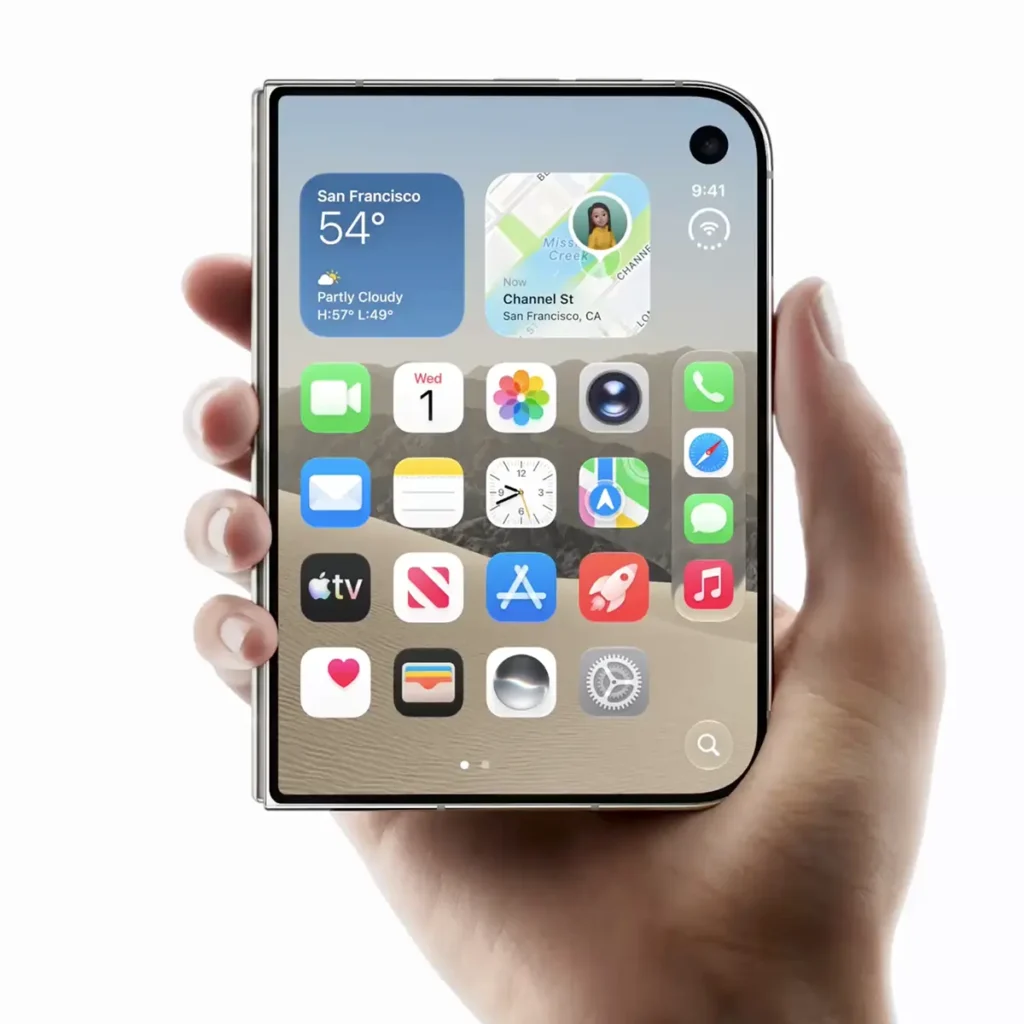
Yes, the premium nano-texture finish on the 7.6-inch inner Super Retina XDR display not only reduces glare and reflections but also creates a matte surface that “minimizes crease visibility and feels great to touch.” And that is it. Nothing more on it. Not even the effort to try to show on screen the crease situation. Folks, I fear the worst.
But I guess only time will tell whether the display can withstand countless folds. Speaking of which, I don’t recall Apple promising how many folds it can sustain either—both qualities Samsung and numerous Chinese phone makers have happily placed on the table as selling points.
Apple did, however, reveal quite a bit about what is beneath that folding display. The custom polymer cover layer is said to be up to 40 percent stiffer than other materials used in the industry, while high-strength glass sits above and below the display panel. Custom adhesives allow the layers to slide past one another like pages in a book to reduce stress at the bend, and a titanium plate reinforces the entire assembly from underneath.
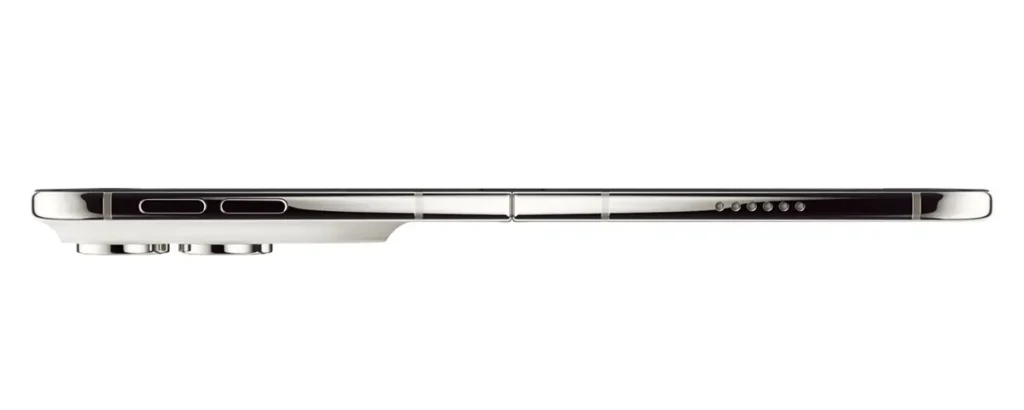
Meanwhile, the precision hinge comprises more than 100 components and supports the center of the display as the phone opens and closes. Internal ribs add stiffness, while ceramic-fiber inserts reinforce the antenna splits in the frame. That is a fair amount of engineering devoted to reassuring anyone who still remembers the early years of folding phones, when removing what looked like a screen protector could result in a very expensive visit to customer service.
Two iPhones for the Space of One

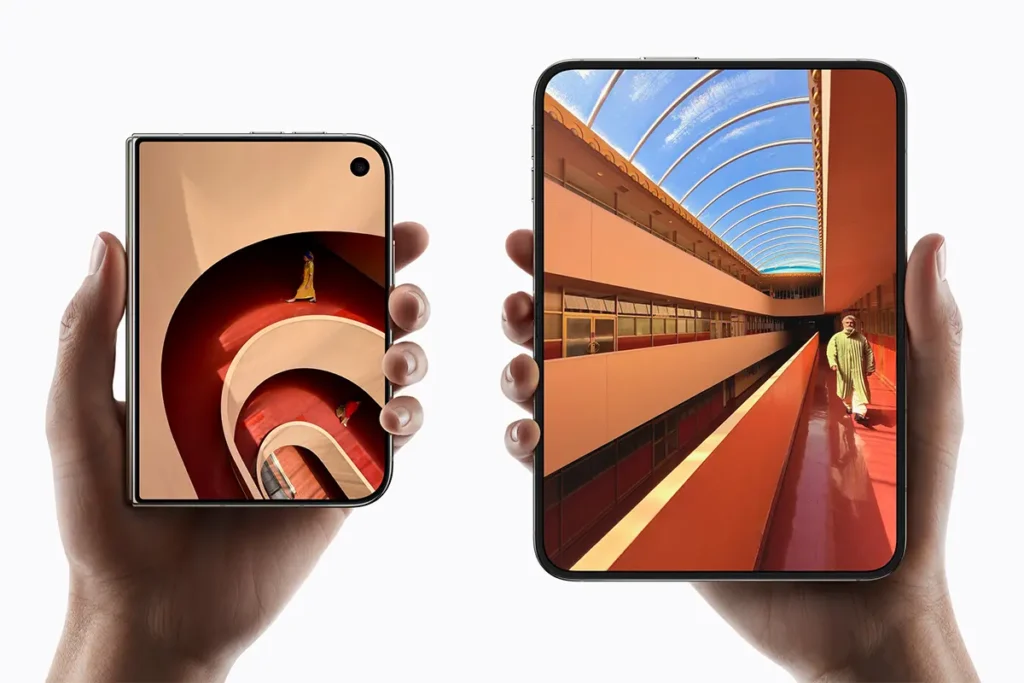
Closed, the iPhone Duo presents a 5.4-inch outer Super Retina XDR display with 90 percent of the screen area of the iPhone 18 Pro. Apple says that makes it comfortable for one-handed use and suitably pocketable, which will appeal to anyone who misses the days when phones did not require the hand span of a concert pianist.
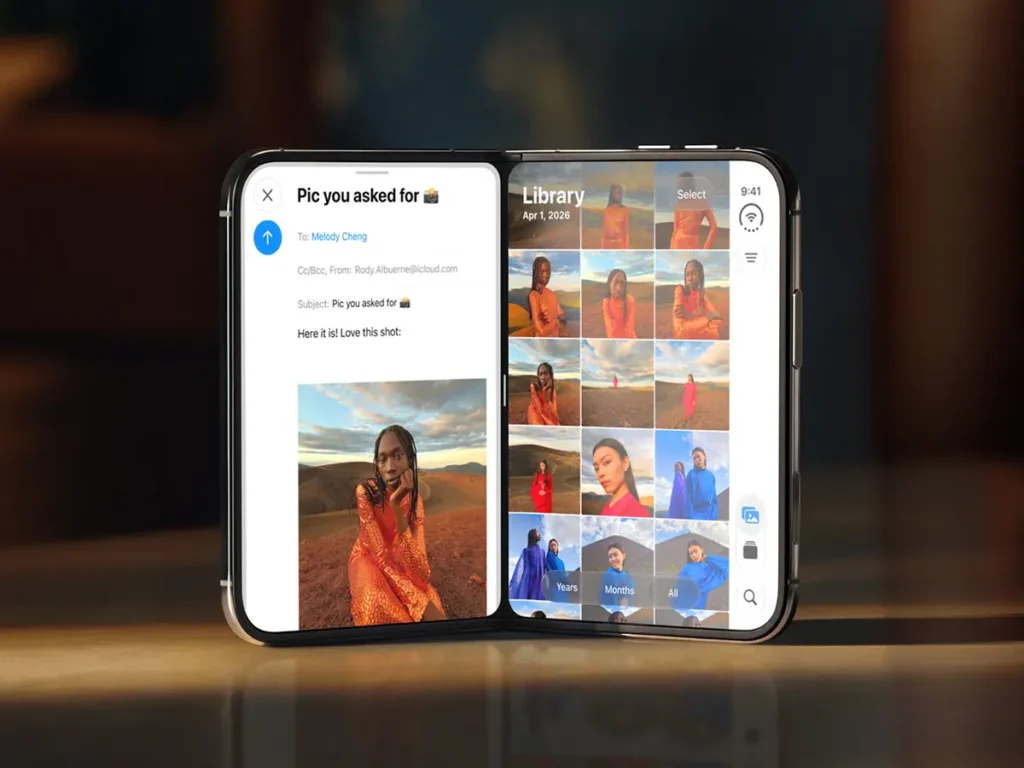
Open it, and you get Apple’s largest iPhone display yet: a 7.6-inch Super Retina XDR panel said to offer 50 percent more screen area than the iPhone 18 Pro Max. The inner and outer screens use the same aspect ratio, allowing content to resize proportionally instead of transforming into a strangely cropped approximation of what you were just looking at.
Both displays support ProMotion, Always-On functionality, and up to 3,000 nits of outdoor peak brightness. The inner screen also conceals a FaceTime camera beneath the display when it is not in use, leaving the enormous canvas uninterrupted.
Later this year, the iPhone Duo will support Apple Pencil with USB-C on either display. Yes, you can apparently write on the outside screen, unfold the phone, and continue on the inside. Whether doing so repeatedly will make you feel productive or merely indecisive remains to be seen.
Apple has chosen Touch ID instead of Face ID, integrating the fingerprint sensor into the side button so it remains accessible in either configuration. The phone can also be unlocked using an Apple Watch. Camera Control is present, too, complete with a new Siri Camera mode that lets Siri see what you see and answer questions about it. What could possibly go wrong?
A Foldable iPhone That Understands It Folds
The hardware is only half the story. Apple has adapted iOS 27 around the iPhone Duo instead of simply stretching the familiar iPhone interface across a larger rectangle.
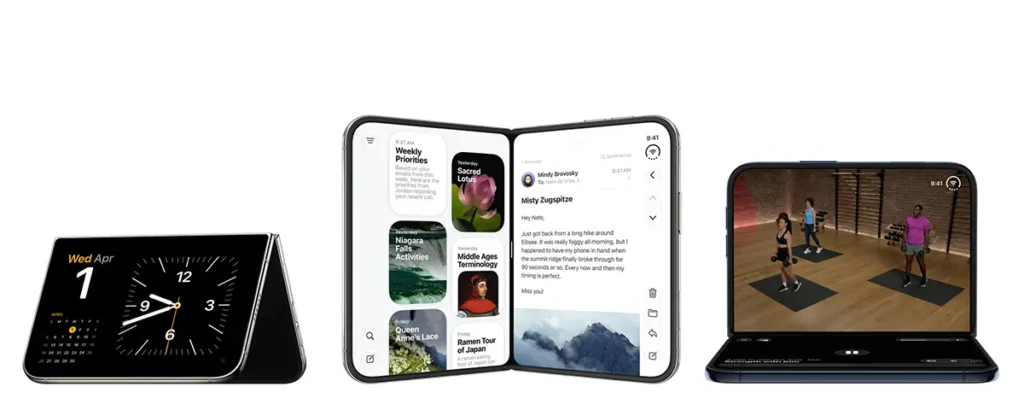
When opened, the phone can display two Home Screen pages, with Today View sitting to the left. Interface controls move toward the sides to preserve vertical space, while the status bar and Dynamic Island have been redesigned to occupy the corners and edges. Content responds as the phone folds, rotates, flips over, or switches between its two displays.
Apple apps are optimized for the format, while Netflix, Zoom, and Slack are among the third-party apps already using the folding design. More importantly, Split View finally allows two apps to run side by side on an iPhone. You can open two Safari windows, swap between apps, save app pairings, or converse with Siri AI on one side while viewing content on the other.
Android foldables have been doing variations of this for years, of course. Apple has merely arrived after checking that the table was stable, the chairs were comfortable, and everybody had finished beta-testing the furniture.
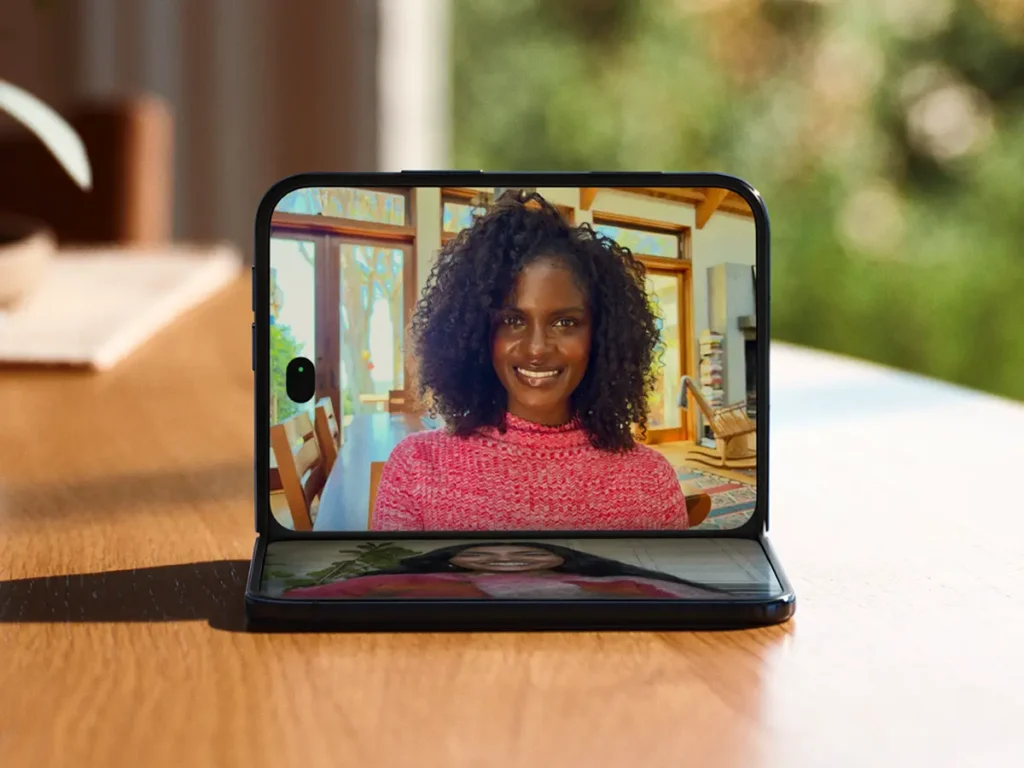
StandBy also works on either display without the phone having to be connected to a charger. Prop the Duo open, and it can become a clock, photo frame, weather display, calendar, or widget hub. Basically, it can pretend to be a tiny smart display whenever it is taking a break from being a US$1,999 (!?) phone. Yes. I know. The price is a shocker.
Cameras That Take Advantage of the Fold
The rear camera system consists of a 48-megapixel Fusion Main camera with sensor-shift optical image stabilization, an optical-quality 2x crop, and zero shutter lag, plus the same 48-megapixel Fusion Ultra Wide camera found on the iPhone 18 Pro models. The latter handles wide-angle shots and macro photography.
There is no dedicated telephoto camera, which may feel like an unusual omission on Apple’s most expensive iPhone. Then again, fitting two displays, two batteries, a vapor chamber, and a hinge with more than 100 components into one folding body presumably involved a few tense internal meetings.
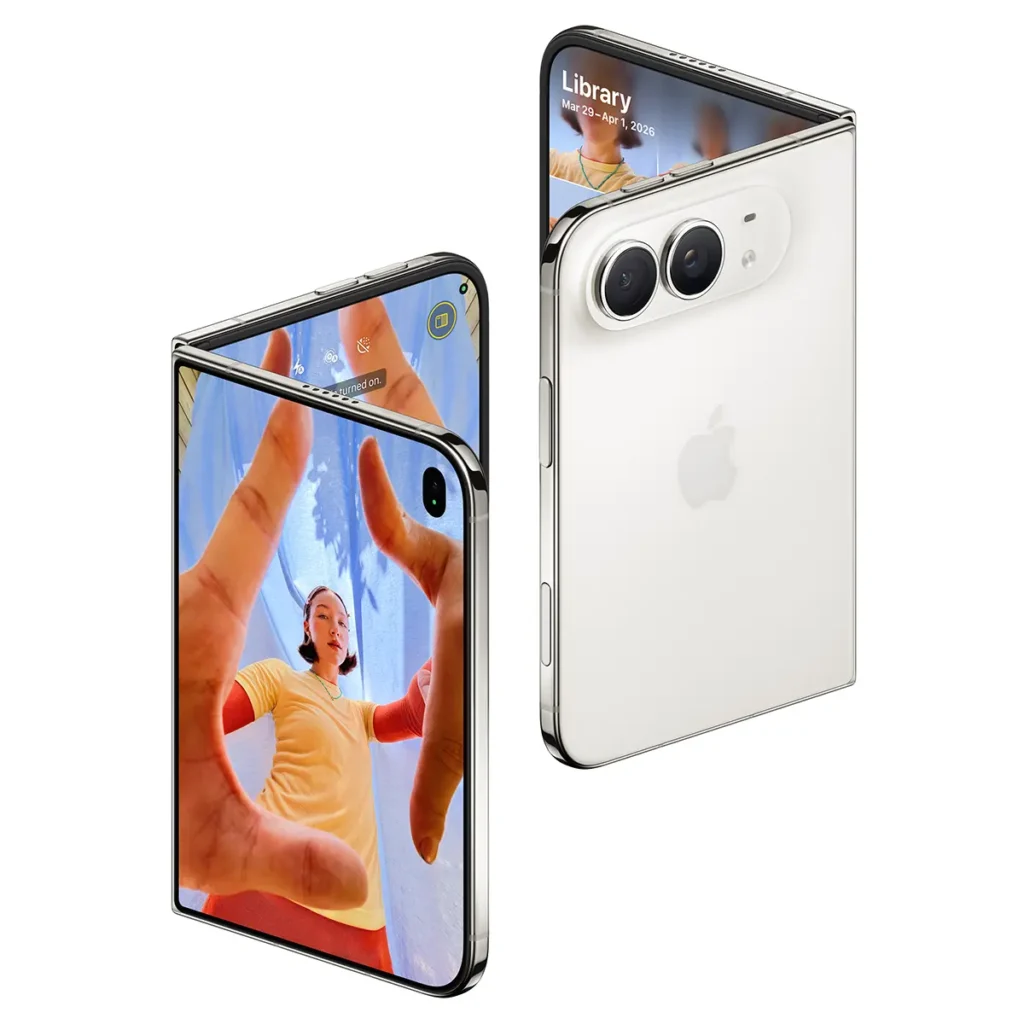
The folding design does introduce several useful camera tricks. You can take higher-quality selfies using the rear cameras while previewing the image on the outer display. Duo Preview gives your subject the same live view so they can adjust their pose and framing, while Kid Cue plays Peanuts animations on the cover screen to persuade children to look at the camera. It may also work on adults, depending on how much Snoopy is involved.
Smart Take uses on-device AI to recognize when everyone is posing and automatically captures the photograph, saving the person behind the camera from sprinting into position before a timer expires. Duo FaceTime lets people standing beside you appear on the outer display and join a call without everyone crowding around the same side of the phone.
For video, the main camera supports 4K recording at 120 fps in Dolby Vision. Cinematic effects can be applied after capture at up to 60 fps, while Audio Mix can isolate music and improve vocal clarity. Since the Duo can support itself in a partially folded position, it can also record hands-free without a tripod.
Pro Hardware in a Complicated Sandwich
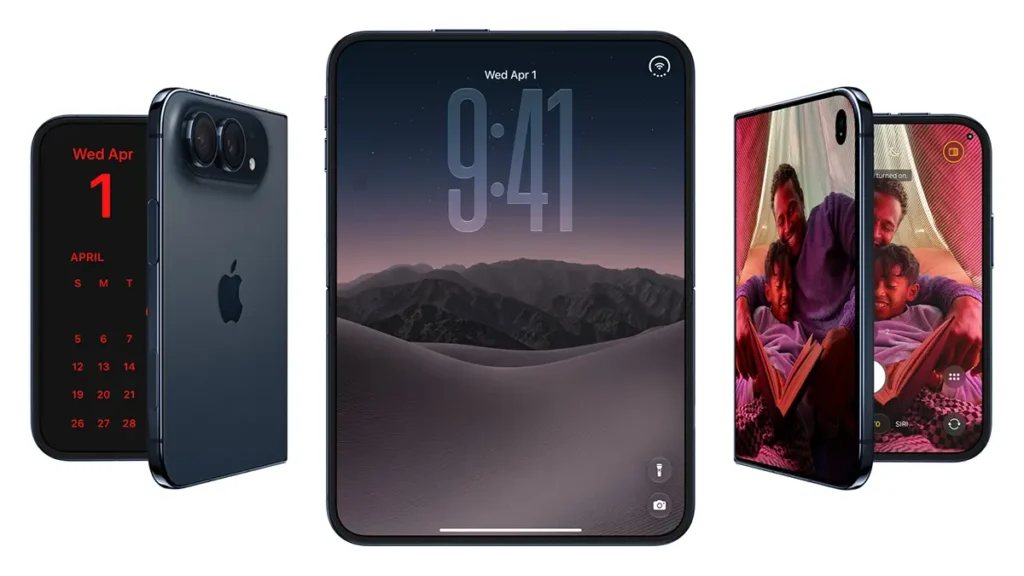
Power comes from the new 2-nanometer A20 Pro—the same chip used by the iPhone 18 Pro models. Apple claims its six-core CPU is up to 20 percent faster than the A19 Pro, while the seven-core GPU is up to 40 percent faster and more power-efficient. A pair of 16-core Neural Engines provides twice the computing power for on-device AI, supported by 50 percent more unified memory bandwidth.
Apple has connected the chip directly to a custom vapor chamber using packaging inspired by M-series Apple silicon. The company claims up to 35 percent better sustained performance than the iPhone 17 Pro, which should be useful when gaming, multitasking, editing media, or discovering that two demanding apps can generate heat twice as enthusiastically as one.
One battery sits inside each half of the phone. Apple does not disclose their combined capacity, but it promises up to 31 hours of video playback using the inner screen, 44 hours using the outer display, or 24 hours of mixed use across both screens. The iPhone Duo can reach 50 percent charge in around 20 minutes using a compatible wired setup or around 30 minutes through MagSafe or Qi2.
The phone is eSIM-only worldwide, freeing up internal space for those batteries while ensuring that anyone still emotionally attached to a physical SIM tray has one more thing to mourn.
Titanium Outside, Siri AI Inside
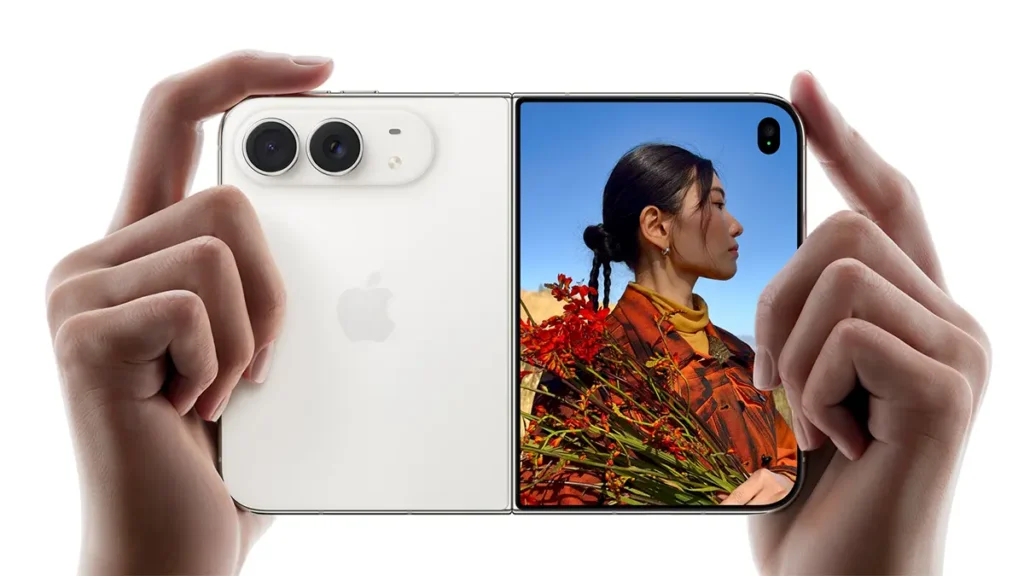
The iPhone Duo uses a Grade 5 titanium enclosure with a mirror-polished finish, paired with a 3D-printed titanium hinge cover sporting a contrasting micro-blasted texture. Ceramic Shield protects the rear, while Ceramic Shield 2 on the front promises three times better scratch resistance than the previous generation. The entire phone carries an IP68 rating for dust and water resistance.
Apple Intelligence and the beta version of Siri AI are deeply integrated into iOS 27. Siri can use personal context from messages, emails, photographs, and other sources; understand what is displayed onscreen; and take related actions. The larger inner display allows the assistant to occupy one side while your content remains visible on the other.
Spatial Reframing, Extend, and an upgraded Clean Up tool can alter photographs after they have been taken, while Image Playground now supports photorealistic output. Apple also plans to support SynthID for identifying AI-generated or AI-edited images. Siri AI will initially support English, with more languages following, although it will not be available in the EU at launch.
The Price of Joining Apple’s Fold
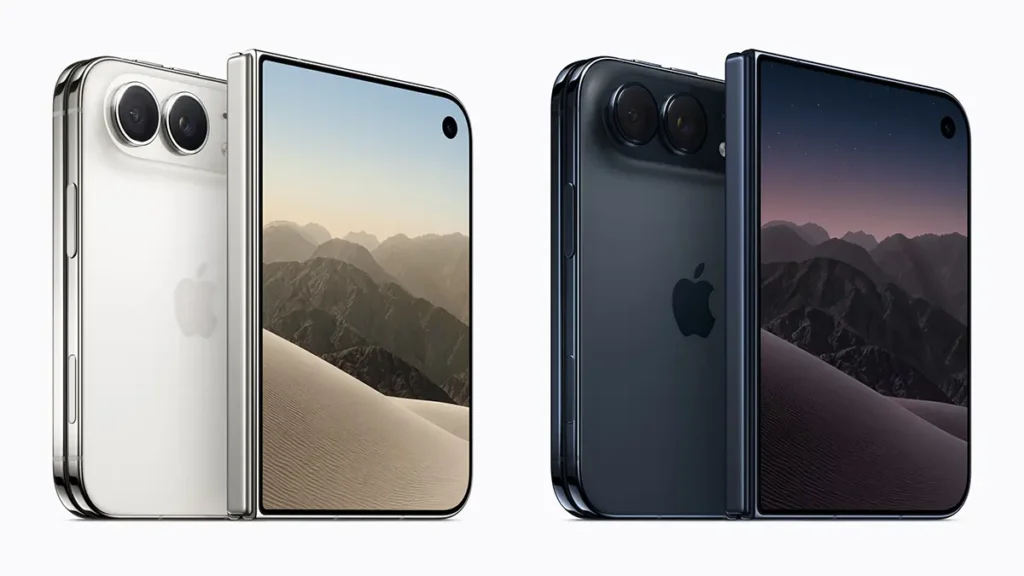
The iPhone Duo will be offered in Star White and Night Sky with 256GB, 512GB, 1TB, or 2TB of storage. Prices start at US$1,999, which puts it firmly in premium folding-phone territory and makes AppleCare feel less like an optional extra and more like emotional support. But seriously, if you are about to drop a couple grand for a phone, you’d get it covered for as long as possible, especially since this is the first of its kind for Apple. Just saying…
Pre-orders open October 16, 2026, in more than 70 countries and regions, including Singapore, Malaysia, the United States, the United Kingdom, Australia, Canada, China, India, Japan, and South Korea. General availability begins October 23, followed by another 28 markets on October 30.
Apple will also sell a two-piece iPhone Duo Case for US$79 and an iPhone Duo Folio with an integrated kickstand for US$129. Both support MagSafe and Qi2 charging.
So, Apple’s first foldable is not merely an iPhone that bends. It has a purpose-built operating system, genuinely useful dual-screen camera features, serious internal reinforcement, desktop-like multitasking, and enough processing power to handle whatever Siri AI eventually becomes.
But the crease and long-term folding durability remain the two sizable elephants bending in the room. Apple says the crease is minimized. It says the phone is built to last. It does not tell us how flat that inner display will look under harsh lighting or how many openings and closings it can endure before age begins announcing itself down the middle.
For US$1,999, those are not trivial details. We will have to wait until the iPhone Duo reaches actual hands—and survives actual pockets—to find out whether Apple has perfected the folding phone or simply given the crease a very expensive nano-texture disguise.
*I have seen an Oppo Find N6 unit that was left as a functional display model for customers to muck around with. After a couple of months on display, presumably handled by countless people visiting the store in a shopping mall, the crease remains, well, impossible to feel. Not only that. It is barely visible unless you deliberately look for it.


Images: Apple.