


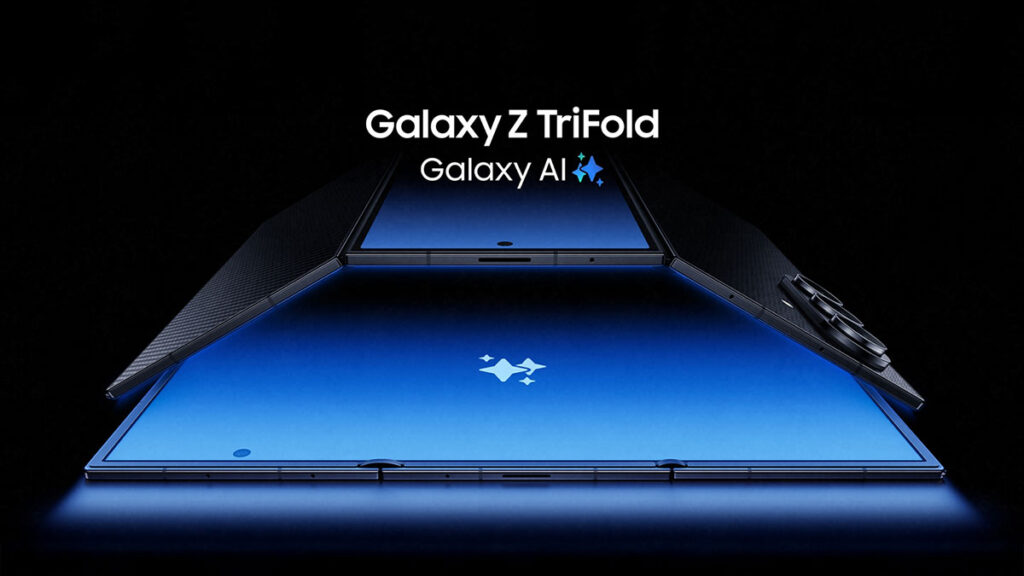
You heard it was in the works, and now it is finally official. We are talking about Samsung’s first-ever trifold phone, the Samsung Galaxy Z TriFold. Samsung has officially become the second company to offer a tri-folding device after Huawei, which overtook the Korean electronics giant by introducing the world’s first trifold phone last year and following up with a successor this September. I guess it is good news for anyone outside of China who wants a “tablet” that fits in the pocket.

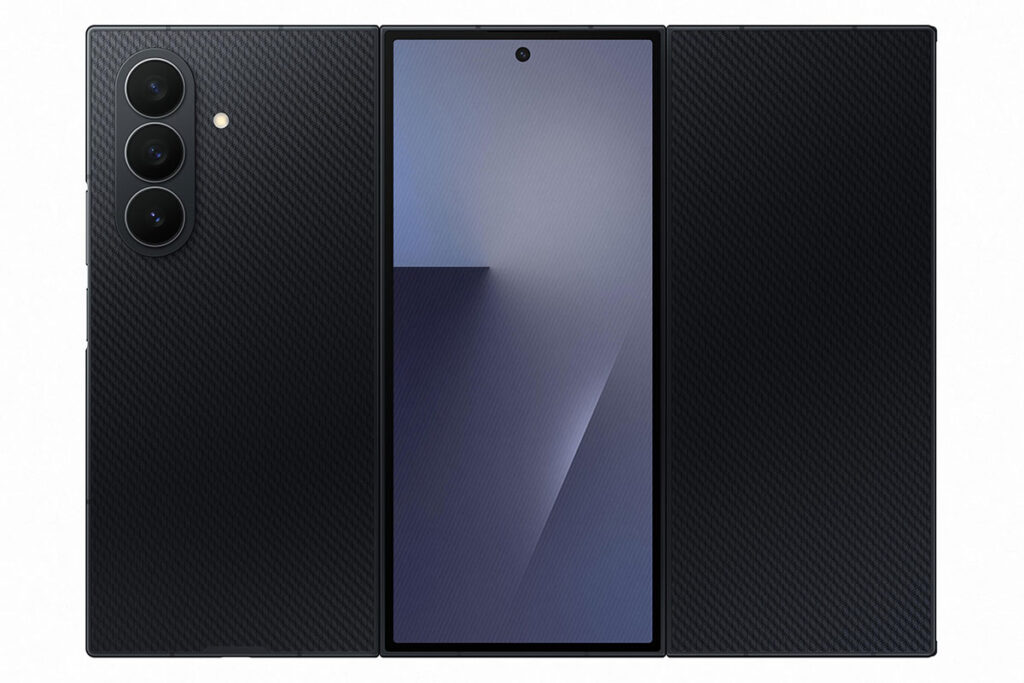
Samsung’s trifold device arrives just in time for the AI revolution, since in the mobile AI era, you do want to be able to see more at a glance and spend less time scrolling. Or maybe it is simply because the population is growing older and bigger screens make reading easier on ageing eyes. Jokes aside, the new Samsung Galaxy Z TriFold is indeed an exciting device.
When folded, it has a 6.5-inch Dynamic AMOLED 2X cover screen with FHD+ (2,520 x 1,080 pixels) resolution, a whopping 2,600 nits peak brightness, and 1–120 Hz adaptive refresh rate. The cover further benefits from Corning Gorilla Glass Ceramic 2. Unlike Huawei’s Mate XTs/Mate XT, which have an accordion-style folding method, Samsung’s trifold opens left and right like a codex-style book.
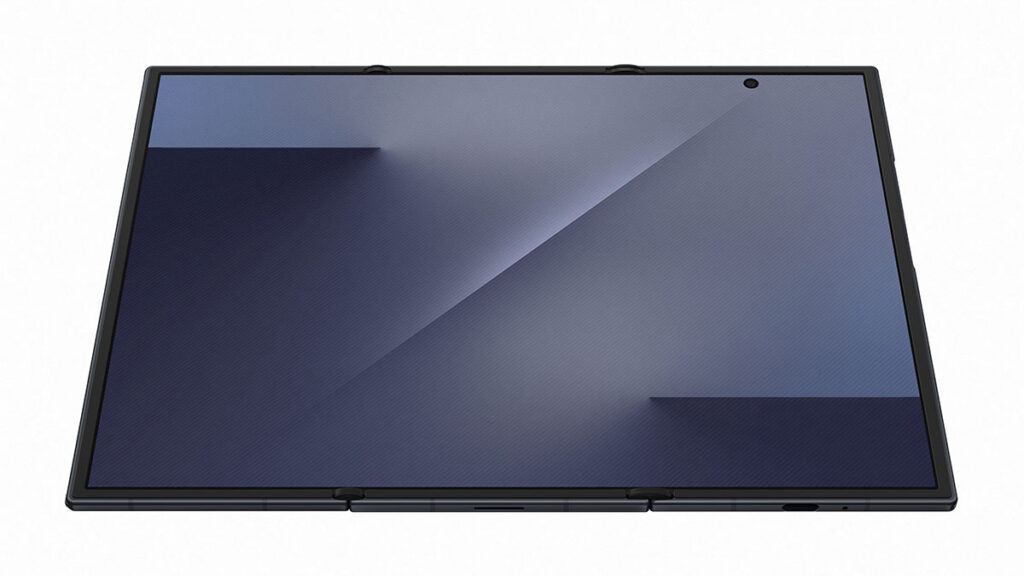
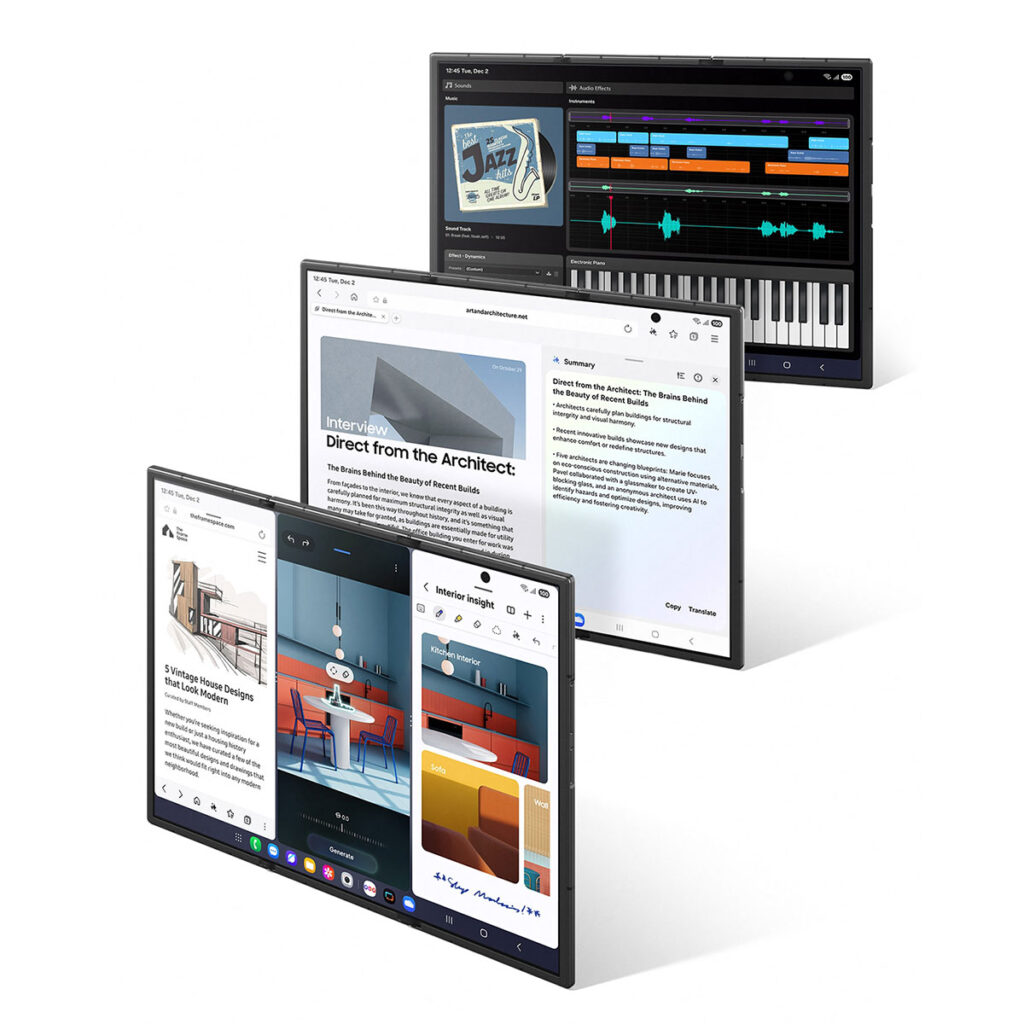
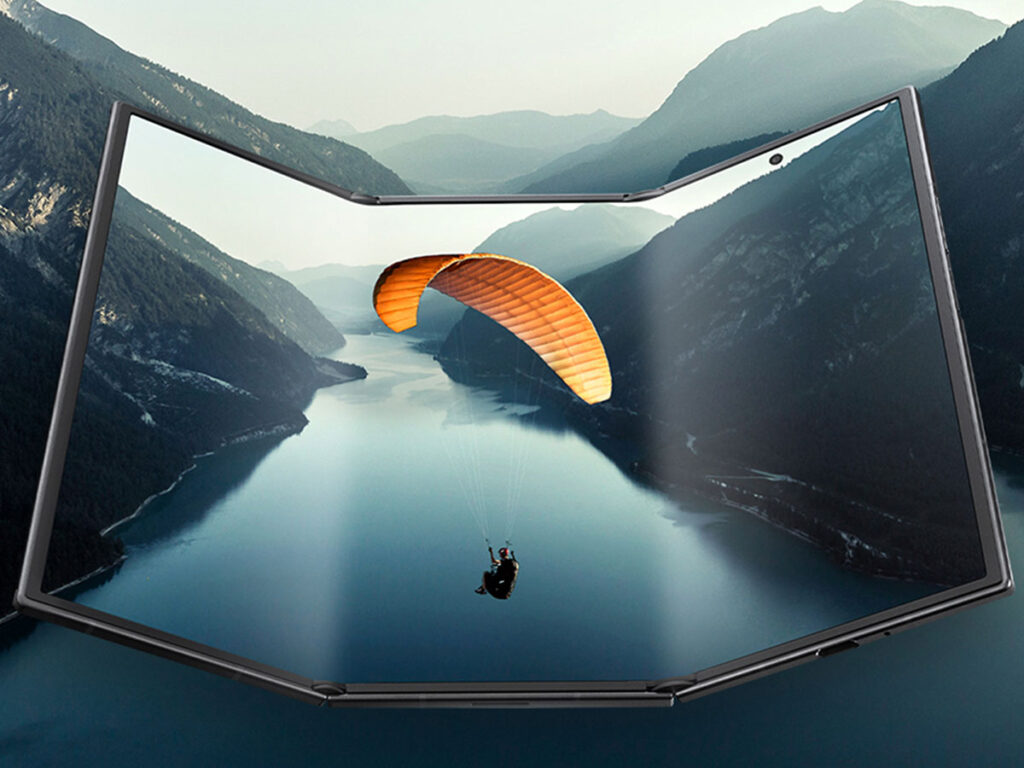
The main display—which is clearly the co-star of the show along with the hinges—is a massive 10-inch Dynamic AMOLED 2X boasting a QXGA+ (2,160 x 1,584 pixels) resolution, 1,600 nits peak brightness, and the industry-standard 1–120 Hz adaptive refresh rate. This folding display touts a reinforced overcoat with a shock-absorbing layer for better resistance across the dual-folding device.
And then there is the other half of the folding equation: the hinges. Samsung said they are the most advanced yet. Building on the Armor FlexHinge used in the Z Fold7, the new Z TriFold features two differently sized hinges with a dual-rail structure, allowing them to work in harmony for a smoother, more stable fold despite the varying weight and components across the device.

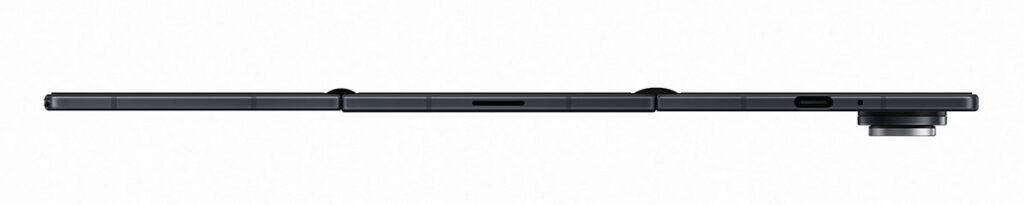
The refined-for-trifold hinges enable the screen panels to close securely with minimal gap for a thinner—and in trifold speak, of course—more portable device. Rounding up the hinge tech is the titanium hinge housing with a thin metal shield to protect the folding mechanism and resist wear over time. Meanwhile, the frame is bolstered by Advanced Armor Aluminum to ensure the screens do not touch each other, and a ceramic–glass fiber-reinforced polymer back panel keeps the device thin while resisting cracks.
Samsung achieved all this while maintaining an ultra-thin 3.9 mm profile at the thinnest point. It is not the thinnest—that title remains Huawei’s—but it is significantly thinner than the world’s thinnest folding device when fully considered as a trifold. You have to take your hats off to Samsung’s engineers for creating such a thin mainboard, and to Qualcomm for producing a powerful chip with a profile slim enough to make this possible.
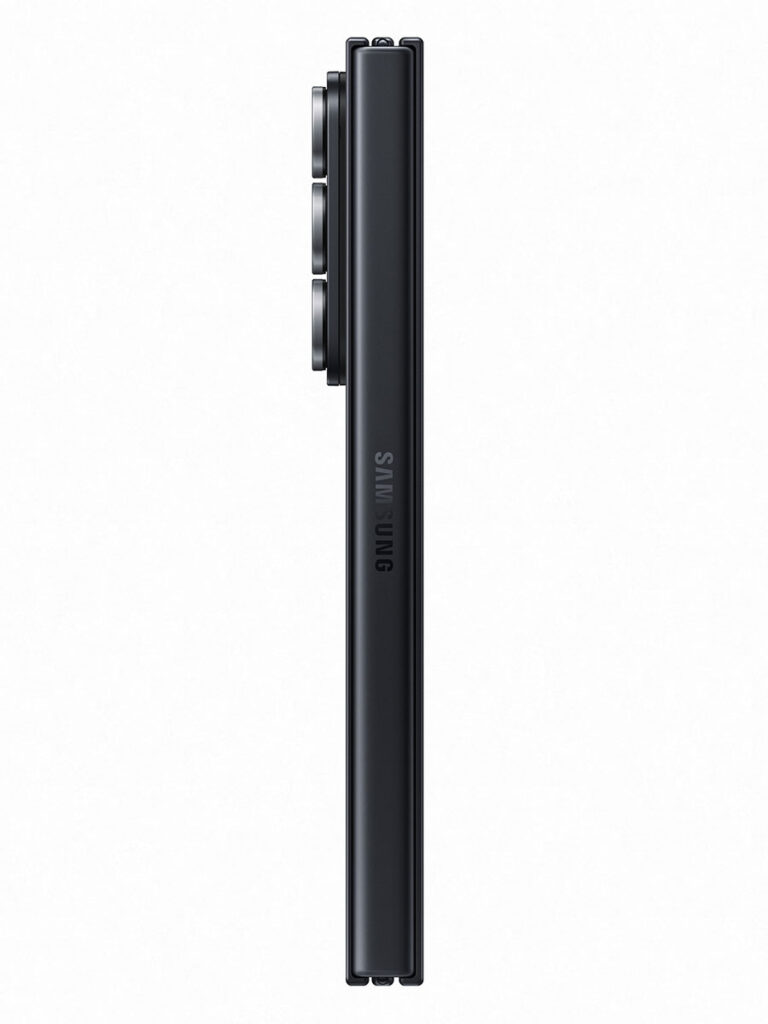
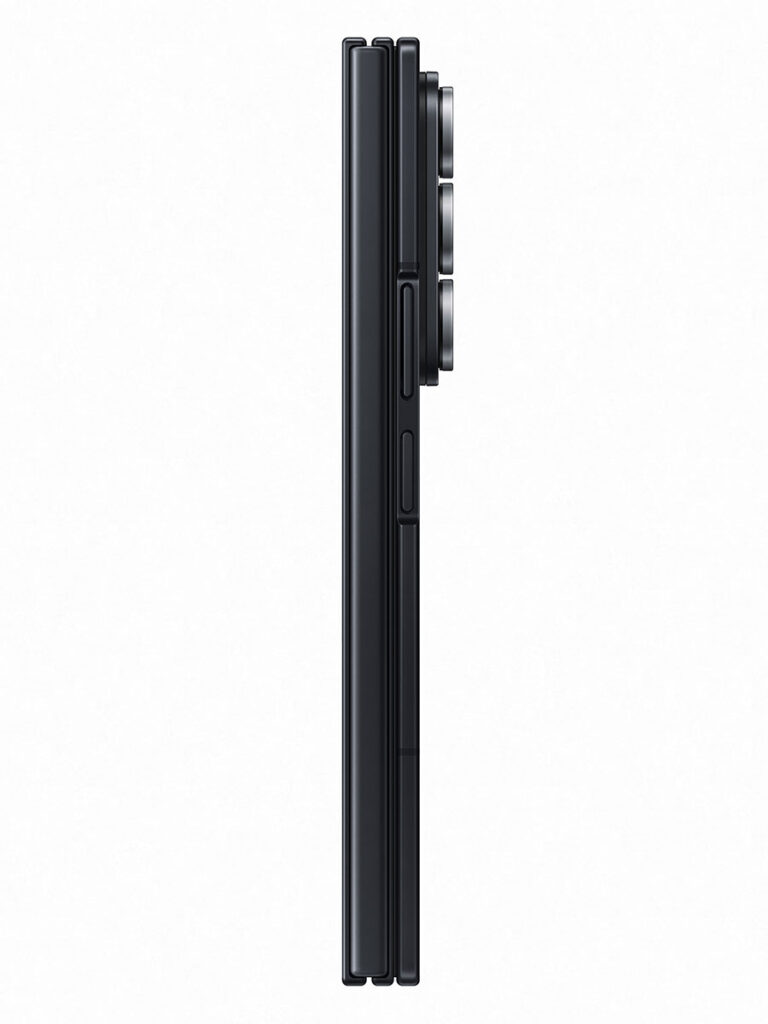
All told, this big guy measures 159.2 mm long, 75.0 mm wide, and 12.9 mm thick when folded, and 159.2 mm long, 214.1 mm wide, and as thin as 3.9 mm when unfolded. It does weigh quite a bit, though, at 309 g.
Under the hood, the Galaxy Z TriFold features the Snapdragon 8 Elite Mobile Platform for Galaxy, 16 GB of memory of unknown type, and 512 GB or 1 TB storage, also of unknown type. Over in the imaging department, it has a triple camera setup in a vertical arrangement similar to the Z Fold7 and S25 series. The cameras comprise a 12 MP ultra-wide dual-pixel AF camera, a 200 MP wide-angle quad-pixel AF camera with OIS and 2x optical zoom, and a 10 MP telephoto camera with PDAF, OIS, 3x optical zoom, and up to 30x digital zoom.
It has a 10 MP selfie camera with an 85° FoV on the cover screen and a 10 MP main selfie camera on the main screen with a wider 100° FoV. Power comes from a 5,600 mAh three-cell battery that supports Super-Fast Charging 2.0 (45 W), Fast Wireless Charging 2.0 (15 W), and Wireless PowerShare.
Other details include an IP48 rating, 5G and LTE radios, Wi-Fi 7, Bluetooth 5.4, a capacitive fingerprint sensor on the side, Samsung Knox with Samsung Knox Vault, dual nano-SIM support, multi-eSIM, and the usual suite of sensors and positioning systems. The device runs Android 16 overlaid with One UI 8.
The Samsung Galaxy Z TriFold will first launch in Korea on December 12, 2025, with a starting price of 3,590,400 won [KR] (about 2,442 US dollars). The device will be launched in China, Singapore, and the UAE later this month.



Images: Samsung.