MedTech quality management has entered a period of structural change. For years, many companies treated quality systems as compliance repositories, built to satisfy auditors, support document control, and preserve evidence after decisions had already been made. That model is increasingly insufficient in a market where product complexity, global regulatory scrutiny, software-driven devices, and compressed commercialization timelines all converge. Quality is no longer a department that validates work at fixed checkpoints. It is becoming the operating system for how medical technology companies design, build, approve, monitor, and improve products.
The pressure is not theoretical. Device makers must manage design history, risk controls, supplier performance, clinical evidence, postmarket signals, complaints, corrective actions, change records, and regulatory submissions as part of one connected lifecycle. When these elements sit in disconnected systems, the organization loses the ability to see cause and effect clearly. A late design change can ripple into risk files, labeling, validation protocols, supplier requirements, and submission content. Without a connected quality management system, those links often depend on manual follow-up, institutional memory, and spreadsheet discipline.
This is why connected quality management systems are moving from operational preference to competitive necessity. The companies that modernize quality infrastructure gain a clearer view of risk, faster access to evidence, and stronger confidence in compliance posture. They can identify issues earlier and respond with better documentation. They can reduce the friction between product development, regulatory affairs, quality assurance, and operations. Most importantly, they can make quality a source of business velocity rather than a constraint on progress.
From Static Compliance to Connected Intelligence
Traditional quality systems were designed for stability, not speed. They performed reasonably well in environments where product lines changed slowly, documentation was largely paper-based, and regulatory submissions followed predictable pathways. Modern MedTech organizations operate under a different set of assumptions. Devices increasingly combine hardware, software, data, services, and external dependencies. A quality system that merely stores documents cannot keep pace with the speed at which product evidence now changes.
Connected quality management systems create a more dynamic relationship between information, process, and accountability. They bring design controls, risk management, training, supplier quality, CAPA, complaints, audits, and change management into a shared digital environment. This does not simply improve recordkeeping. It changes how decisions are made because teams can see dependencies before they become compliance gaps. The result is a more informed organization, one that can act on quality signals while there is still time to influence outcomes.
That shift is also changing how MedTech leaders assess the technology beneath quality management. The goal is no longer to replace paper records with digital folders, but to connect requirements, risks, evidence, submissions, and product decisions across regulated development. This broader move toward intelligent infrastructure is reflected in the work of companies such as Enlil, which focuses on connected quality management for medical device teams. Its emphasis on traceability, regulatory alignment, and faster execution mirrors the priorities now shaping the market. A related Enlil article on practical QMS implementation for MedTech teams reinforces this trend, showing how leaders are moving beyond digitized binders toward systems that support faster, more defensible decisions.
Why Disconnected Quality Systems Create Business Risk
Disconnected systems rarely fail all at once. They fail gradually, through delays, duplicated work, unclear ownership, outdated records, and decisions made with incomplete context. In MedTech, those failures can become expensive because quality information is not peripheral to the business. It is central to regulatory approval, market access, product safety, manufacturing continuity, and customer trust. When quality data is fragmented, leadership loses the ability to understand where the organization is exposed.
The most visible cost is operational drag. Teams spend hours reconciling documents, chasing approvals, confirming whether a requirement changed, and determining whether a downstream file reflects the latest product decision. Engineers may update a design input without a clean connection to associated risk controls. Regulatory teams may prepare submissions while waiting for quality records to be verified. Quality teams may discover late that a change requires additional training, validation, or supplier review. Each gap may look manageable in isolation, but together they slow the organization and increase the chance of error.
The larger risk is strategic. A MedTech company that cannot connect its quality evidence may struggle to scale across product lines, geographies, and regulatory regimes. It may find that growth creates more process friction rather than more leverage. It may also face higher risk during audits, inspections, acquisitions, and product launches because evidence must be assembled manually under time pressure. In a capital-intensive industry, that inefficiency can erode margins, delay revenue, and weaken confidence among regulators, customers, and investors.
The Role of Traceability in Modern Product Development
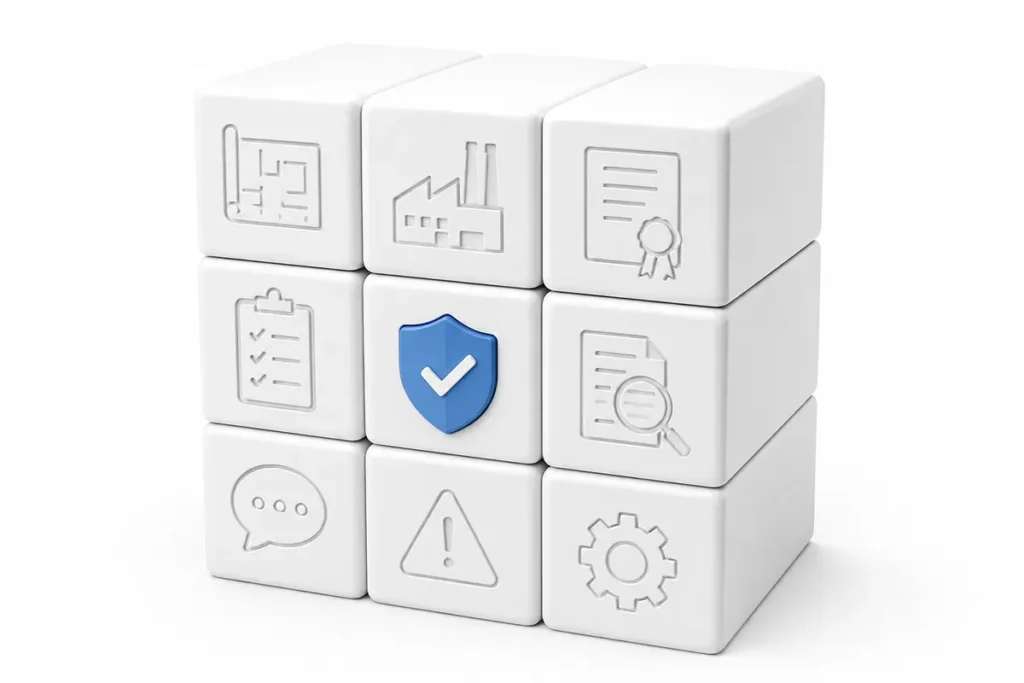
Traceability has become one of the defining capabilities of a mature MedTech quality system. It is not enough to document that work was completed. Companies must be able to show how requirements connect to risks, how risks connect to mitigations, how mitigations connect to verification, and how verification supports claims made in regulatory submissions. In software-enabled devices, this requirement becomes even more demanding because changes may occur frequently and affect multiple layers of the product architecture. Traceability gives organizations a way to preserve clarity as complexity increases.
A connected quality management system makes traceability a living capability rather than a retrospective exercise. Instead of assembling matrices late in the development cycle, teams can maintain relationships between artifacts as work progresses. A design change can trigger review of related requirements, hazards, test cases, and labeling implications. A complaint trend can be linked back to risk documentation and corrective actions. A supplier issue can be evaluated in relation to affected components, production lots, and field performance.
This matters because traceability is increasingly tied to business speed. Companies that lack clear traceability often move slowly when questions arise because every answer requires investigation. Companies with connected traceability can respond faster because evidence is already structured and accessible. That can shorten review cycles, reduce late-stage surprises, and strengthen readiness for regulatory engagement. It also gives leadership a more accurate view of whether a product is truly ready to advance from development to submission, launch, or scale.
How Connected QMS Platforms Improve Regulatory Readiness
Regulatory readiness is often misunderstood as a final-stage activity. In reality, it is built over the life of a product. Every requirement, design decision, risk assessment, test result, complaint investigation, and quality action contributes to the evidence base that regulators may eventually examine. If that evidence is inconsistent, incomplete, or difficult to retrieve, the organization faces avoidable friction. Connected quality management systems help companies maintain readiness continuously rather than trying to manufacture it at the end.
The advantage comes from linking quality workflows to regulatory obligations in a practical way. A connected system can help ensure that design controls, risk files, CAPA records, training evidence, audit findings, and change histories remain aligned. It can reduce the gap between what teams do and what they can prove. This is especially important for companies navigating multiple jurisdictions, where expectations may vary but the need for coherent evidence remains constant. A strong system does not eliminate regulatory complexity, but it helps make that complexity manageable.
Regulatory readiness also affects credibility. When a company can produce clear, connected, and current evidence, it signals operational discipline. Regulators and notified bodies are not merely reviewing documents. They are evaluating whether the organization has control over its processes and products. A connected QMS gives MedTech companies a stronger foundation for answering questions with confidence. It also reduces the burden on teams that would otherwise spend critical time assembling evidence manually during inspections, submissions, or market expansion.
Quality as a Driver of Speed, Not a Barrier to It
For many organizations, quality has historically been perceived as a gatekeeping function. It is brought in to review, approve, correct, or stop work when compliance concerns emerge. That perception is changing because the pace of MedTech innovation no longer allows quality to operate at the end of the line. When quality processes are disconnected from development, they become a bottleneck. When they are embedded into the operating model, they become an accelerant.
Connected quality management systems help create that shift by reducing the cost of coordination. Teams can collaborate around a shared source of truth instead of relying on scattered files, email threads, and manual trackers. Approvals become more transparent. Responsibilities become clearer. Evidence is easier to find and evaluate. The organization spends less time asking whether the process was followed and more time improving the process itself.
Speed in MedTech cannot come at the expense of rigor. The point of a connected QMS is not to make quality lighter or less demanding. It is to make quality more precise, more visible, and more integrated into the decisions that shape product outcomes. Companies that achieve this balance can move faster because they have fewer hidden issues. They can scale with more confidence because their processes are repeatable. They can innovate with less organizational drag because quality is part of the workflow rather than an interruption to it.
The Business Case for Connected Quality Management
The financial argument for connected quality management begins with efficiency, but it does not end there. Reducing manual reconciliation, duplicate documentation, and delayed approvals can produce meaningful operational savings. However, the larger value comes from reducing risk and improving decision quality. In MedTech, delayed launches, failed audits, unresolved CAPAs, and poorly controlled changes can carry costs far beyond administrative overhead. A connected QMS helps companies limit those costs before they become visible on the income statement.
There is also an important scalability argument. A young device company may be able to manage quality through a patchwork of tools, especially when the product portfolio is narrow and the team is small. As the company grows, that patchwork becomes harder to defend. More products, more suppliers, more markets, and more regulatory expectations create a level of complexity that manual systems cannot absorb efficiently. Connected quality management provides infrastructure that can grow with the business.
Investors, acquirers, and strategic partners increasingly view quality maturity as a signal of enterprise value. A company with disciplined quality systems is often better positioned for diligence, expansion, and commercial execution. It can demonstrate control over product evidence, risk management, and operational processes. It can also reduce the uncertainty that often surrounds regulated businesses. In that sense, a connected QMS is not merely a compliance investment. It is a business asset that supports growth, resilience, and long-term credibility.
What MedTech Leaders Should Expect from the Next Generation of QMS
The next generation of quality management systems will be judged by how well they connect work across the product lifecycle. Document control alone will not be enough. Companies will expect systems that support intelligent traceability, workflow automation, risk visibility, regulatory alignment, and cross-functional collaboration. They will also expect systems that can adapt to the realities of software-driven devices and increasingly complex development models. The market is moving toward platforms that understand quality as an integrated business function.
AI will likely play a growing role in this transition, especially where teams need to classify information, identify gaps, surface dependencies, and accelerate evidence preparation. The promise is not that AI replaces quality judgment. The promise is that intelligent systems can reduce the burden of manual review and help experts focus on higher-value decisions. In a regulated environment, that distinction matters. Automation must support accountability, not obscure it.
MedTech leaders should therefore evaluate connected QMS platforms through a strategic lens. The question is not simply whether a system can manage documents, route approvals, or record nonconformances. The question is whether it can help the organization understand its products, risks, obligations, and evidence with greater clarity. Companies that answer that question well will be better positioned to compete in a market where quality performance and business performance are increasingly inseparable. Connected quality management is becoming less of a technology upgrade and more of a management discipline for the next era of MedTech.
Disclaimer: This article is intended for informational purposes only and does not constitute regulatory, quality management, legal, or professional advice. Medical device companies should evaluate their specific operational, compliance, and regulatory requirements and consult qualified professionals when selecting or implementing quality management solutions. Any companies, platforms, products, or services mentioned are provided for informational purposes only and do not constitute endorsement.


