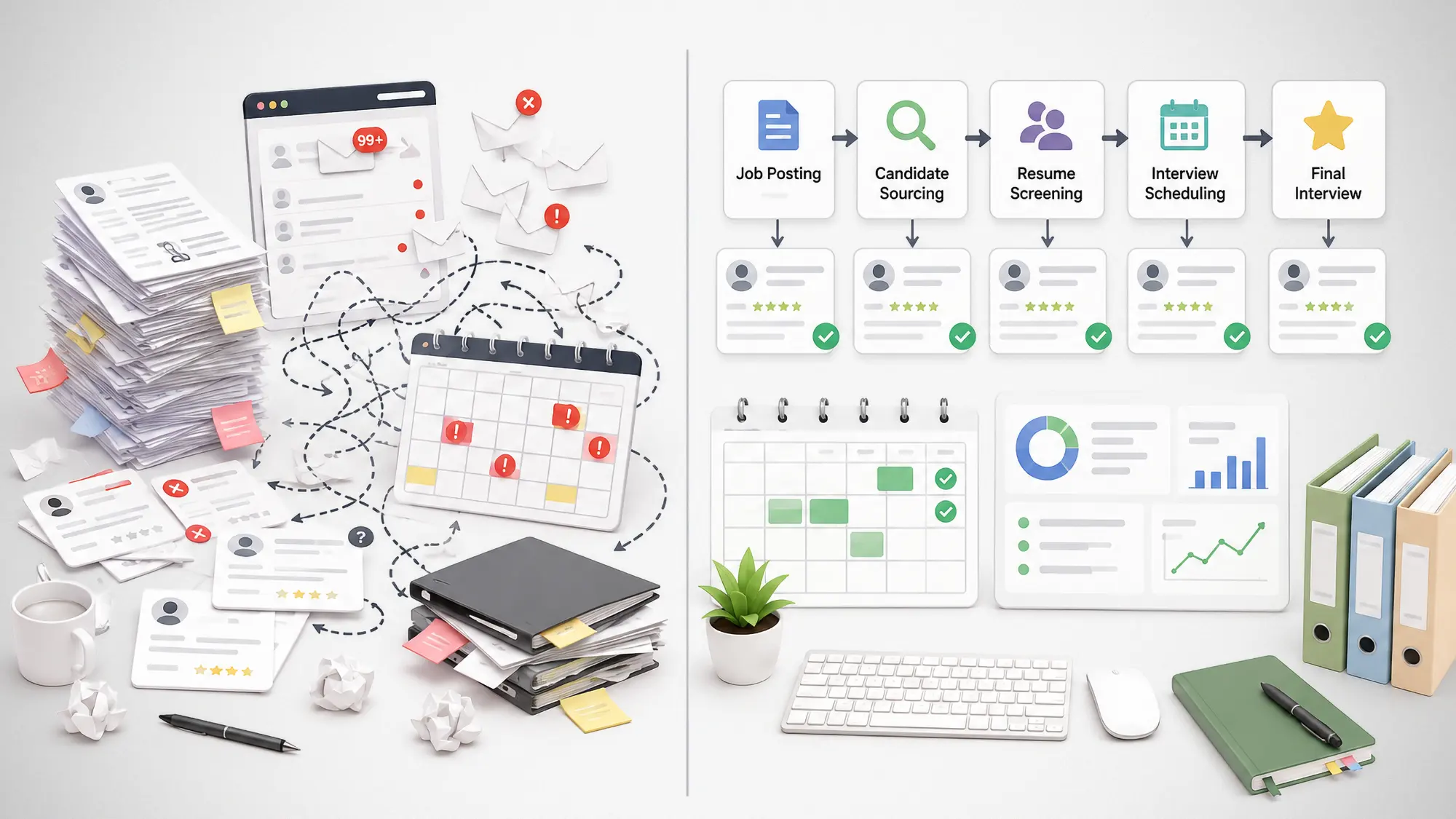
The same tools that have automated customer support, content workflows, and data entry are now reshaping how small businesses handle hiring. AI-assisted sourcing, ATS platforms, and virtual assistants working across time zones are compressing recruitment timelines that used to take weeks of manual coordination.
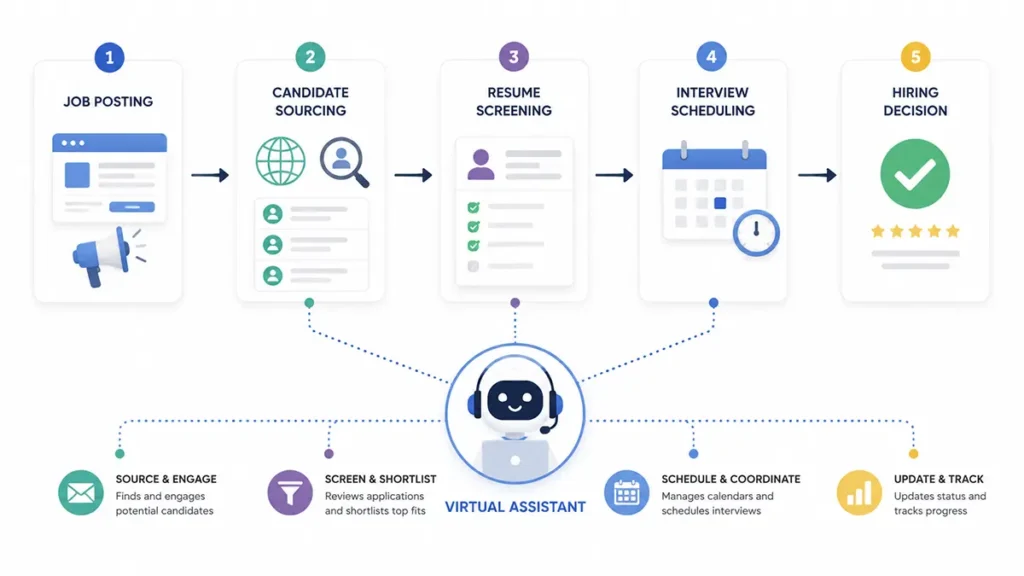
Open roles sit unfilled while you switch between sourcing candidates, reviewing resumes, scheduling screens, and keeping daily operations moving. The issue is often not a lack of applicants. It is a lack of time to move the right applicants through the process.
A recruitment virtual assistant (VA) can help by taking on repeatable, top-of-funnel recruiting tasks. The VA handles time-consuming coordination and admin work so you can focus on decisions that require your judgment, such as evaluating finalists, setting compensation, and extending offers.
Below is a practical two-week playbook for scoping, sourcing, and onboarding a recruitment VA. It includes checklists, task boundaries, and key performance indicators (KPIs) you can use right away. It is general business guidance, not legal advice.
What a Recruitment Virtual Assistant Is and Is Not
A recruitment VA is a remote contractor who supports your hiring pipeline. Typical tasks include:
- Writing and posting job descriptions across job boards
- Sourcing candidates through LinkedIn, databases, and outreach
- Reviewing resumes against agreed screening criteria
- Coordinating interview times and calendar invites
- Updating your applicant tracking system (ATS) with candidate status
- Sending candidate updates, reminders, and follow-ups
- Compiling basic recruiting reports
Some decisions should stay with you. Final hiring decisions, compensation approvals, compliance sign-offs, and legal judgment calls should remain in-house. A contractor should not make offer or pay decisions on the company’s behalf.
Worker classification rules and Equal Employment Opportunity (EEO) requirements still apply when you use outside support, so confirm details with trusted legal, U.S. Department of Labor, and Equal Employment Opportunity Commission (EEOC) resources when needed.

Is a Recruitment VA Right for Your Business?
Not every team needs recruiting support. Use this quick checklist before you hire:
- Hiring volume: Are you filling two or more roles per quarter?
- Role repeatability: Do your open roles share similar profiles, requirements, or sourcing channels?
- Documentation readiness: Do you have, or can you quickly create, job descriptions, screening criteria, and outreach templates?
- Tooling: Do you use an ATS, shared inbox, or calendar system that a remote worker can access safely?
- Data sensitivity: Can you limit system access without exposing unnecessary personal information?
- Review bandwidth: Can a manager spend 15 to 30 minutes a day reviewing shortlists and giving feedback?
If most answers are yes, delegating recruiting admin to a VA may be a good fit. For small business delegation to work, the VA needs clear criteria and quick feedback, especially during the first few searches. If your hiring is rare, highly confidential, or dependent on deep industry networks, a specialized recruiter or staffing agency may be more useful.
What to Delegate vs. Keep In-House
Clear boundaries protect candidate experience and reduce mistakes. Before you hand off work, write down who owns each step, which templates the VA can use, what information may be shared, and when a manager must review the output.
This keeps recruiting work aligned across scheduling, screening, and inbox management as a form of broader administrative task support instead of turning delegation into guesswork.
Delegate to the VA:
- Job posting and distribution
- Outreach messages and sourcing lists
- Resume screening against defined criteria
- Interview scheduling and confirmation emails
- Reference check coordination
- ATS data entry and pipeline cleanup
- Candidate updates, rejection emails, and next-step messages
Keep in-house:
- Defining the role scope and must-have criteria
- Setting compensation bands
- Conducting final interviews
- Making the offer
- Approving compliance or legal matters
- Granting access to sensitive personally identifiable information unless it is strictly necessary
The 7-Step Hiring Playbook for a Two-Week Sprint
- Define outcomes and success metrics. Decide what faster hiring means for your business. Two useful measures are time-to-fill, the number of days from role approval to accepted offer, and time-to-slate, the number of days to deliver the first shortlist of qualified candidates. Pick one primary KPI.
- Draft a role charter and SOPs. Create a one-page document that explains the VA’s responsibilities, tools, reporting cadence, and escalation path. Add step-by-step standard operating procedures for each recurring task.
- Choose an engagement model. Decide whether you want to hire a freelancer, use a marketplace, or work with a managed provider. The comparison below can help.
- Shortlist and evaluate candidates. Review writing samples, ATS experience, attention to detail, and communication style. Strong candidates ask specific questions about your workflow and hiring criteria.
- Run a paid test task. Give two or three finalists a realistic assignment, such as sourcing 10 candidates for one open role. Use a simple scoring rubric so the comparison is fair.
- Sign a contract, non-disclosure agreement (NDA), and data processing addendum. Define data retention, deletion terms, confidentiality expectations, and the scope of candidate data access in writing.
- Onboard with a 30/60/90-day plan and weekly reviews. Start with close oversight, then reduce check-ins as the VA learns your standards.
Tools, Access, and Security
A recruitment VA usually needs access to your ATS, shared calendar or scheduling tool, approved email templates, sourcing instructions, and interview scorecards.
As AI tools get smarter and more deeply integrated into daily workflows, the gap between human assistants and AI-augmented ones is narrowing fast, making the tooling decisions in this section more relevant than ever.
If you use a shared inbox or candidate email alias, set clear rules for when the VA can reply independently and when they should ask for approval.
When granting access, follow these principles:
- Least privilege: Give only the permissions needed for the task.
- Data minimization: Limit exposure to candidate personal information wherever possible.
- Unique credentials: Never share your personal login. Create a separate account.
- Offboarding protocol: Revoke all access as soon as the engagement ends.
Use an NDA and data processing addendum when a VA handles candidate information or logs into HR systems. These documents should explain what data can be accessed, how long it can be kept, and how it must be deleted after the work ends.
Manage by Metrics
Set a short daily asynchronous check-in and a weekly live review. The daily update can be simple: what was completed, what is blocked, and what needs your input.
Track these KPIs:
- Candidates sourced per week
- Outreach reply rate
- Qualified-submit rate, meaning qualified candidates as a share of total candidates reviewed
- Interviews scheduled
- Time-to-slate
- Drop-off by pipeline stage
Collect a two-week baseline before setting improvement targets. After that, adjust in small steps rather than chasing dramatic gains. Results depend on the role, market, compensation range, and sourcing channels.
Where to Hire: Freelancer vs. Marketplace vs. Managed Provider
Each sourcing model has trade-offs. The right choice depends on your budget, how much oversight you can provide, and how quickly you need support.
| Model | Pros | Cons | Best For |
| Freelancer, direct hire | Lower cost and more control over selection | You handle vetting, training, and backup coverage | Managers with clear SOPs and time to supervise |
| Marketplace, such as Upwork or Fiverr | Large talent pool and built-in payment workflows | Quality varies, and oversight is still required | Short-term or project-based recruiting support |
| Managed provider | Dedicated assistant plus operational oversight | Higher monthly commitment and less direct selection | Teams that want structure without building the process alone |
If you prefer a managed route, review how each provider defines the assistant’s responsibilities, backup coverage, onboarding support, reporting cadence, data handling, and contract terms before you sign.
A provider such as Wing Assistant may be worth comparing against your documented workflow rather than a one-off sourcing project if you want a dedicated recruitment virtual assistant with operational oversight.
For tech-forward teams already using AI tools across their stack, pairing a managed VA with your existing ATS and calendar automation creates a hybrid workflow that handles volume without requiring additional headcount.
14-Day Onboarding Checklist
Days 1 to 2: Grant limited tool access, walk through SOPs, confirm communication norms, and explain how you define a qualified candidate.
Days 3 to 5: Share outreach templates and scorecards. Ask the VA to draft initial messages for your review before sending them.
Days 6 to 10: Run trial sourcing and screening on a live role. Give daily feedback on candidate quality, messaging, and any missed criteria.
Days 11 to 14: Tighten screening criteria based on early results. Finalize the reporting dashboard, agree on weekly KPIs, and define escalation paths for unclear cases.
By the end of the second week, you should have a repeatable workflow and a clearer view of where the VA saves the most time.
Conclusion
A recruitment VA can help speed up your hiring process when the role is well scoped and carefully measured. Keep strategic decisions in-house, give the VA clear criteria, and review the data weekly.
The goal is not to remove your involvement from hiring. It is to reduce manual work so you can spend time on the candidates most likely to succeed. For teams already investing in productivity tech, adding structured VA support to the hiring stack is one of the more straightforward ways to extend those gains into recruitment.
FAQ
These common questions can help you set expectations before hiring a recruitment VA.
How is a recruitment VA different from a recruiter or staffing agency?
A recruitment VA supports the administrative and repeatable parts of your pipeline, such as sourcing, scheduling, and ATS updates. A recruiter or agency may own more of the process, including candidate relationships, negotiation, and closing. A VA works under your direction, while an agency usually works more independently.
What does a recruitment VA typically cost?
Costs vary by experience, location, scope, and engagement model. Freelancers on global marketplaces may charge less per hour than U.S.-based contractors, while managed providers often bundle assistant time with oversight into monthly plans. Define the scope first, then compare quotes.
Can a VA work across time zones?
Yes. Many recruitment VAs work outside your local time zone and can handle sourcing or outreach while your office is closed. Agree on overlap hours for live questions, and use clear asynchronous updates so work does not stall.
Which KPIs matter most early on?
Start with time-to-slate and qualified-submit rate. These show how quickly the VA delivers usable candidates and how well they apply your criteria. Once those stabilize, add outreach reply rate and interviews scheduled.
How do I protect candidate data?
Use an NDA and data processing addendum, grant access on a least-privilege basis, create unique credentials, and revoke access immediately when the engagement ends. For worker classification, EEO obligations, or other legal questions, consult official resources or an employment attorney.