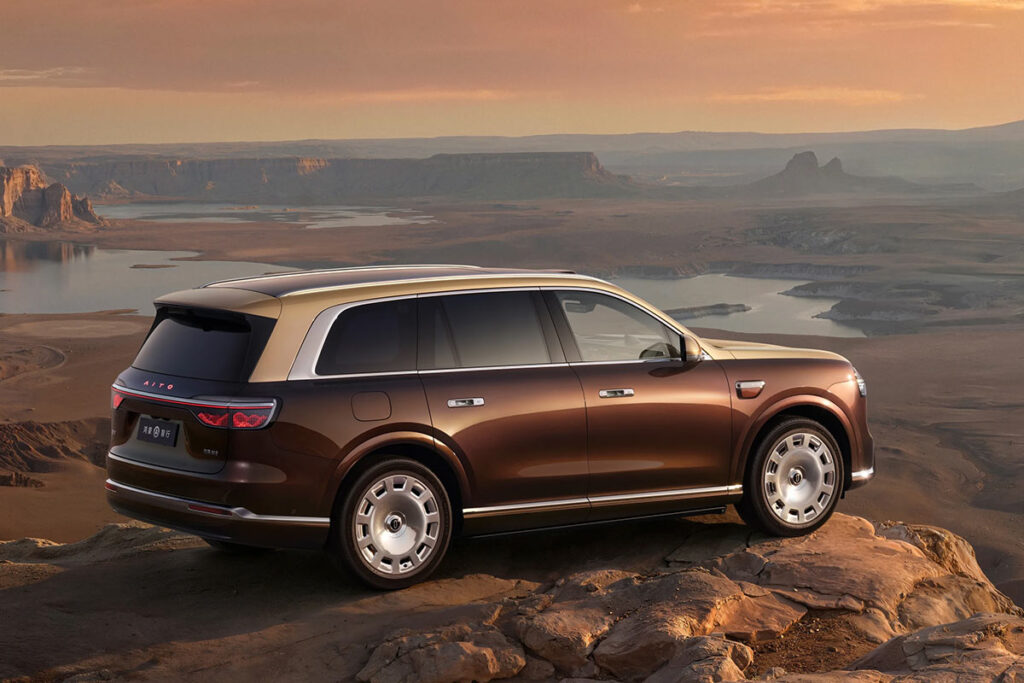
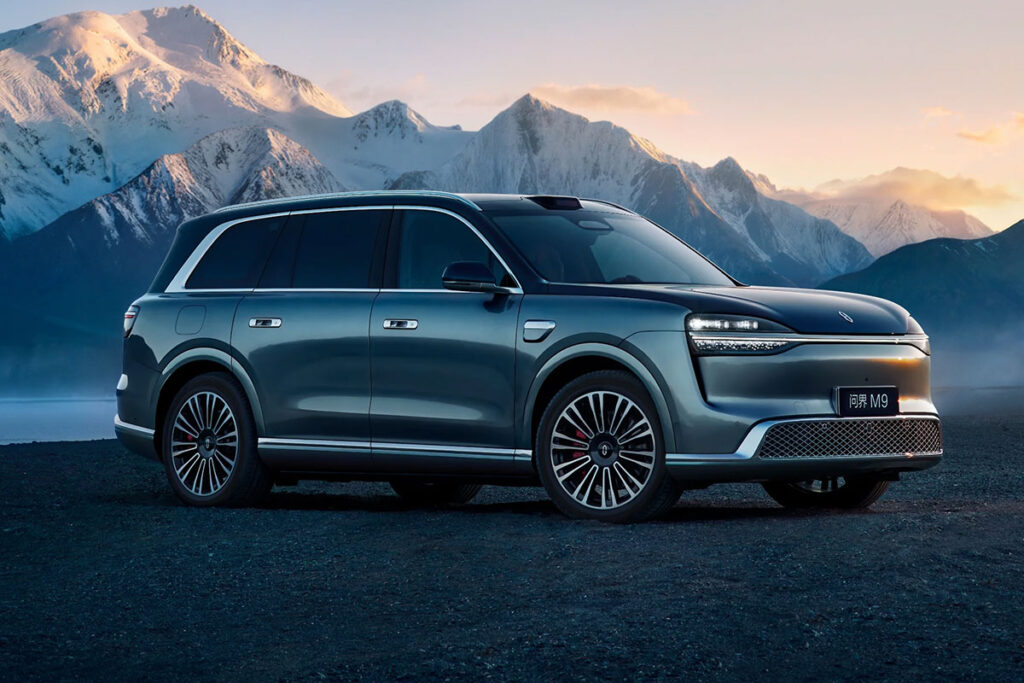
Remember the days when automobiles were just automobiles? These days, cars are mostly software-defined vehicles. In other words, they are basically oversized smartphones with wheels. But AITO, together with partner Huawei, blurs that line even further. The marque’s latest M9 SUV is an SDV mobile entertainment center that wants to ditch the outdoor projector and even say no to hard LCD screens inside the car.
Not going to lie. While I am not a fan of an automobile loaded with gizmos, I am intrigued by what the M9 has to offer in terms of projection.
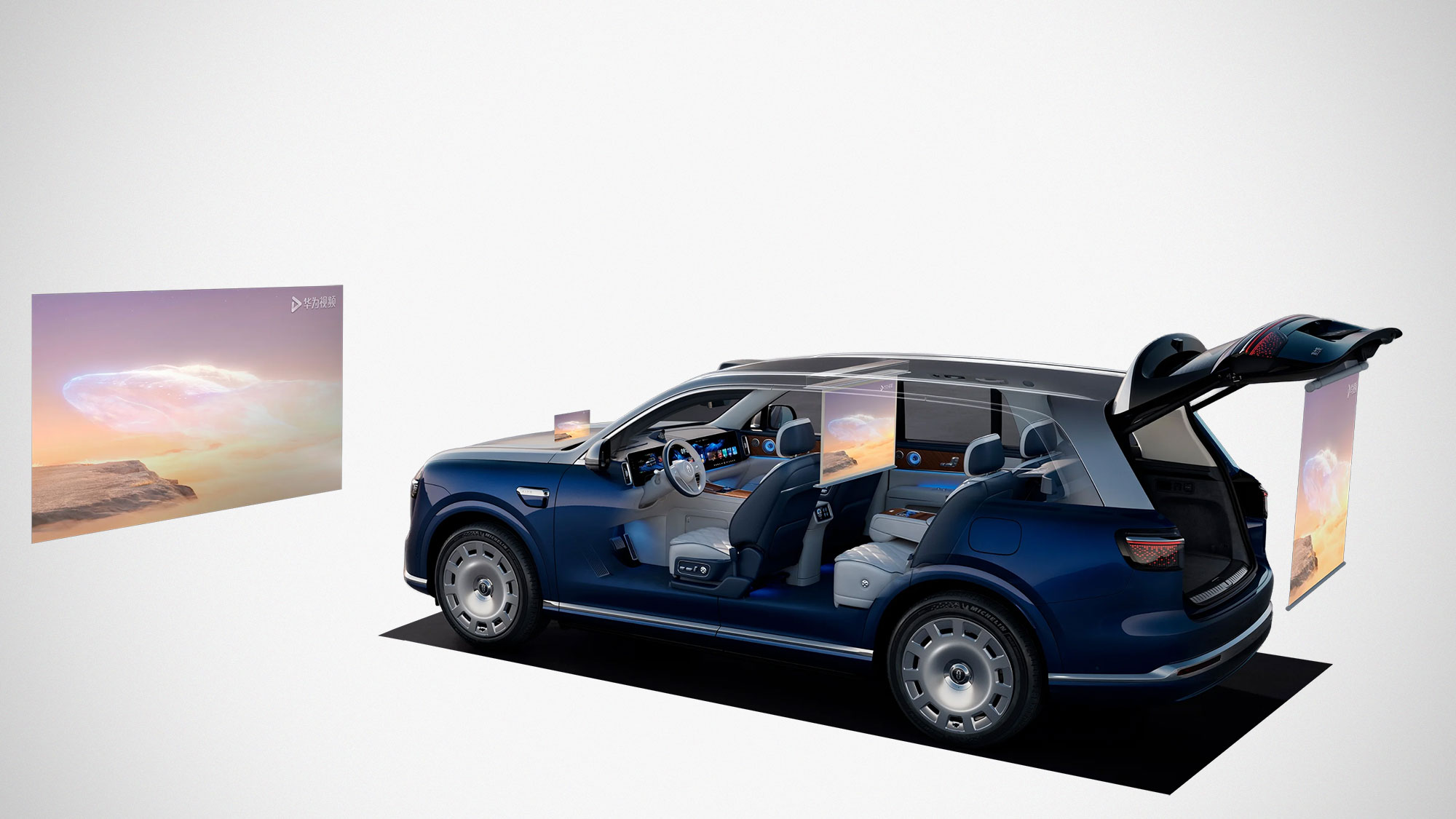
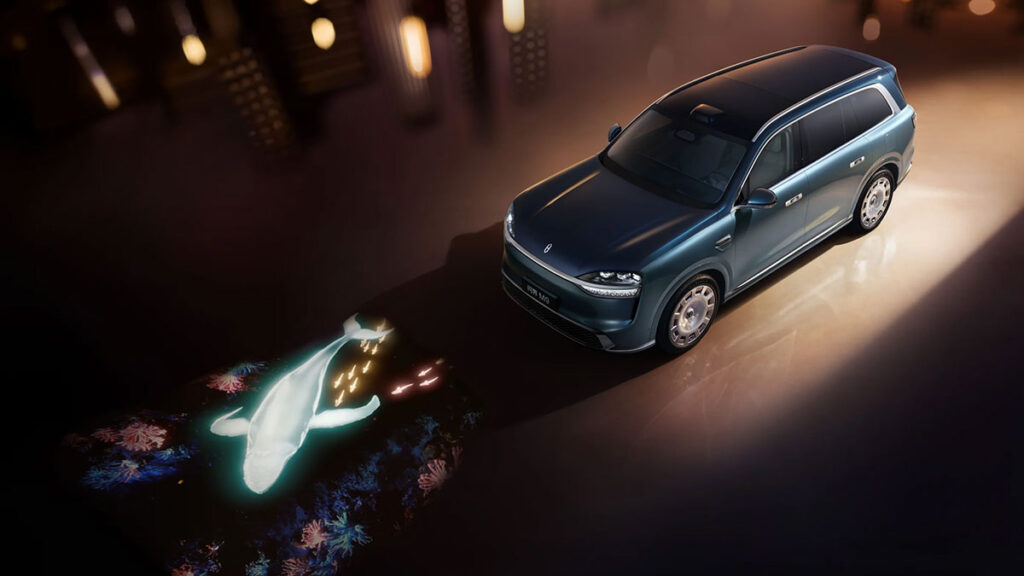
If you don’t already know, the M9 is known for having headlights with a built-in projector, known as Huawei XPixel. Yes. An actual projector—not a light projector, well, actually it is also that. More on that in a sec. The previous-generation XPixel only did monochrome projection. But with the new M9, it has been upgraded to color projection. In addition, it boasts projection inside the cabin at the rear-seat section, as well as rear projection at the tailgate with a specialized screen.
The XPixel can project video images on the floor in front of it, as well as on any vertical flat white surface. Even more interesting is that three M9s can work together to project a large image. However, these fancy color projections for your entertainment are only available when the car is put into ‘P’ position, i.e., when it is parked. When driving, the projector doubles as a light projector, but only white light is available.
As far as projecting your favorite show on vertical surfaces goes, both headlights work together to form a large projected image. It even has an external speaker at the front right corner of the car to provide the audio for your movie screening. It is not limited to videos, though; it essentially lets you cast the entire car’s UI on any vertical surface as long as the environment is dim enough and the surface is reasonably white and flat.
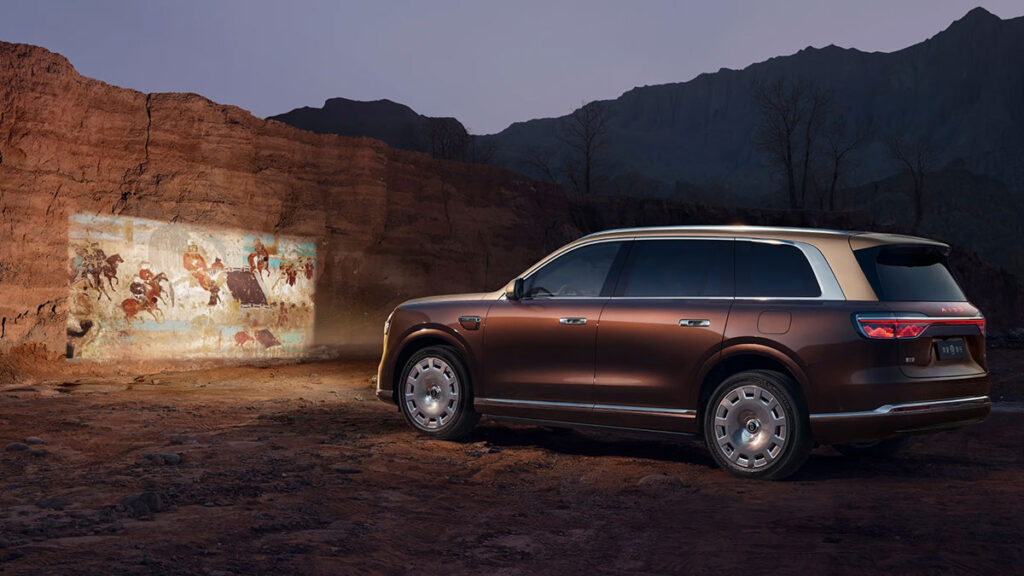
Using a simple three-finger gesture, you can “throw” the car’s UI from the display inside the car to the wall outside. Basically, whatever you want on the screen to be projected, you use the three-finger gesture and drag it upwards and “throw” it outside, as long as it is supported by the system. Armed with a color projection system, it essentially takes away the need for an outdoor projector for your movie night under the stars. But that’s the only projection it has.
The projection technology is not limited to the headlights. There is projection inside the cabin at the rear seats, too. Where most cars have a display or displays on the ceiling, or on the back of the front seats, the M9 has a mini projection screen and an actual projector. The previous generation used a third-party projector mounted behind and above the rear seats. With the latest M9, Huawei developed a low-profile projector that is significantly brighter, with a contrast ratio of 2,000:1 and support for 98% of the DCI-P3 wide color gamut.
In addition, the projector is liquid-cooled to enable quieter operation and eliminate heat introduced into the cabin. It does not end there. The projector supports dual projections, allowing two people to enjoy their own choice of entertainment. Though it is not clear how the audio separation works. I guess each person has to wear headphones to enjoy shows, movies, or games without disturbing the other person.
The projection screen supports image sizes from 20 to 32 inches. For this purpose, the front seats can automatically adjust to ensure the rear passengers have the best room for the best viewing experience. Seriously, this feels like future living now, except that it is not a floating holographic display.
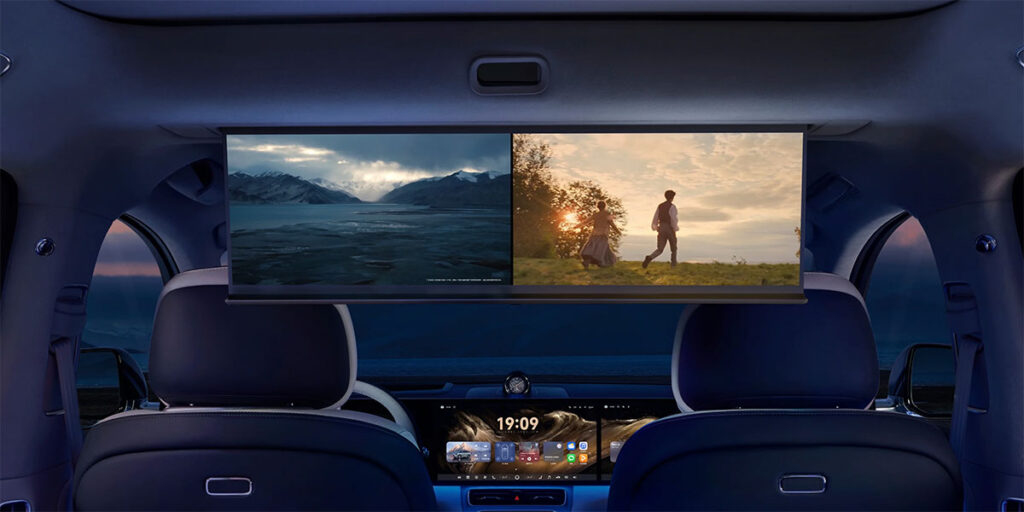
The display can also extend to just a quarter of its length, and, at this screen size, it can display useful information like the time, weather, and the current song that is being played. The in-car projection feature also has a single-person mode, where one side of the screen lets the rear passenger consume entertainment while the other side shows navigation information, for example.
Even more interesting with this mode is that the car knows which side the lone passenger is on. When the passenger moves to the other side, the entertainment and the info screen automatically switch sides. If another person joins the rear seating, the screen automatically centers, removing the info panels and allowing two people to share the same screen.
This projection system serves double duty. It can also project to the rear using dedicated accessories for true tailgate entertainment. In the car’s main control panel, you can choose Open Air Cinema mode, and the display will show the steps. First, the tailgate will open—that’s the car’s job, btw—and then it proceeds to tell you what needs to be set up, which includes securing a special projection screen on the inside of the tailgate and folding down the third-row seat—which, like the opening of the tailgate, is automatic.
In this mode, the tailgate will not open all the way up. It stops at a 90° angle—the perfect height for the projection. An accessory that redirects the projection to the rear has to be attached to the low-profile Huawei projector. This attachment attaches to the projector magnetically and redirects the image to the rear, casting it onto the back of the special-material screen.
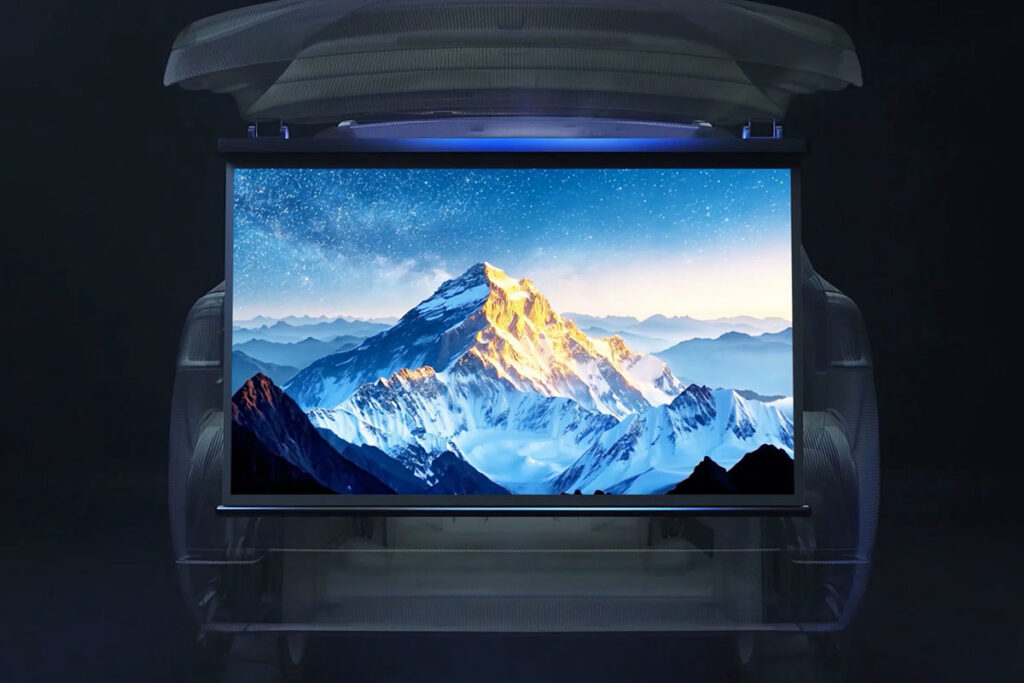
The screen is designed to hang on two concealed hooks. If no wind is expected, you may choose to let the screen hang down, but if there is wind or wind is expected, it has a Y support that anchors the screen’s bottom to the top of the rear bumper to prevent it from flapping around.
Once the hardware has been installed, you have to hit the setup complete button on the main display at the dashboard, and the car will fold the third-row seat, turn off the external lights, and start the projector.
The image reflected by the accessory and projected onto the screen is flipped, but when viewed from the rear of the car, it is the right way around. The screen is not entirely opaque. It is kind of translucent to allow this to happen.
So, there you have it. A car that blurs the line between an appliance and a mode of transport. Perhaps that is what the future holds for us? Perhaps. So, what about the car’s performance? You can be serious, right? We are here for the projection tech, not the car. Just kidding. OK, maybe a little not kidding.
Anyhoo, the car is built on an 800V platform, paired with a 120 kWh battery pack for up to 750 km of CLTC range, and supports quick charging from 30 to 50% in 15 minutes. There is also an 800V extended range edition that has a pure electric range of 422 km, and a combined range of a whopping 1,405 km. The extended range model is outfitted with a 75 kWh battery.
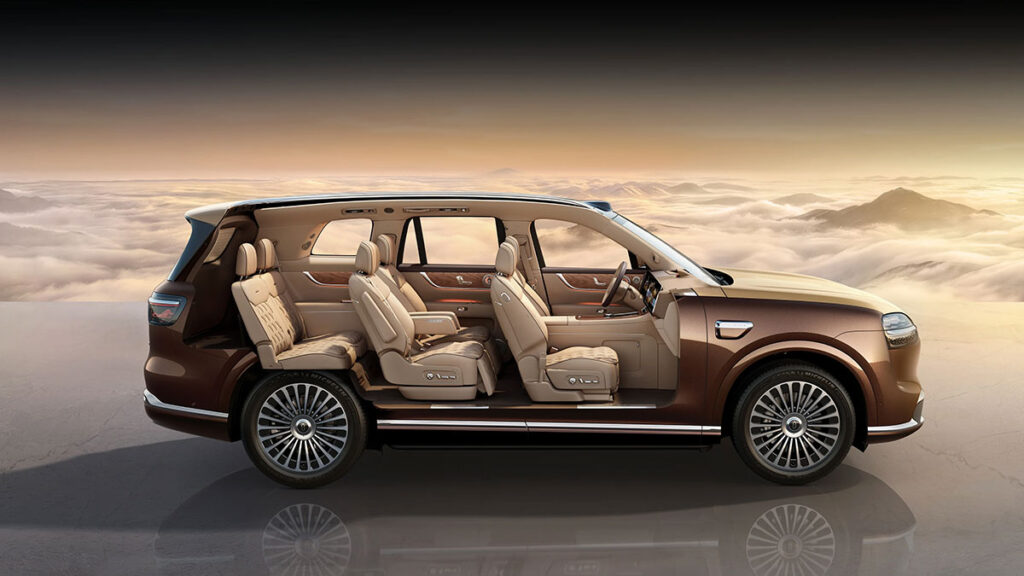
It has a bunch of Huawei tech, but I think we should not dive into that rabbit hole because this automobile really sounds more like a massive piece of electronic gadget than a car. As for the other numbers, it is murky. We try searching, but it looks like there are no official numbers for the horsepower or how quick it is. There is some information, but as I said, it is not clear if those are official numbers or not, so we would rather not say.
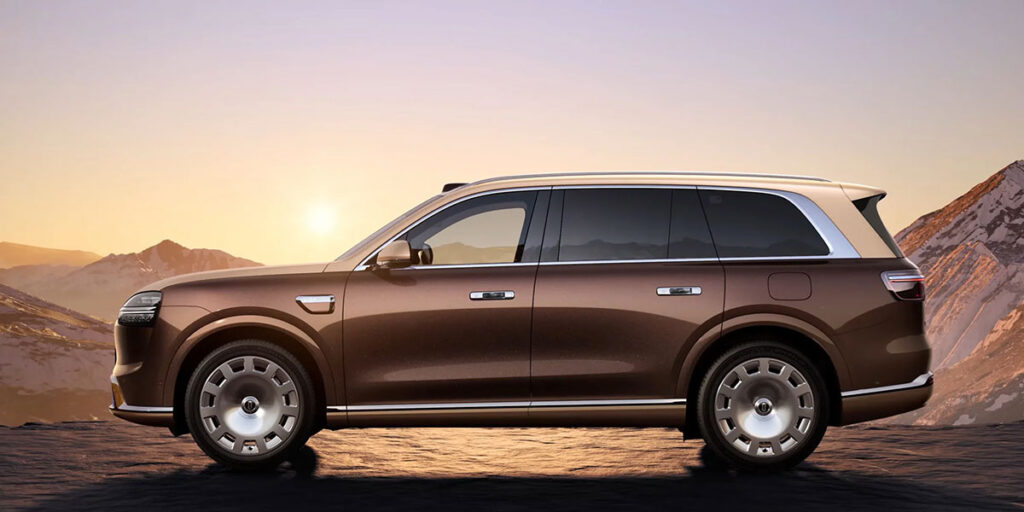
The new AITO M9 has been launched in China with a starting price of 479,800 yuan [CH], and in a choice of Max+, Ultra, and Ultimate.
Images: AITO.