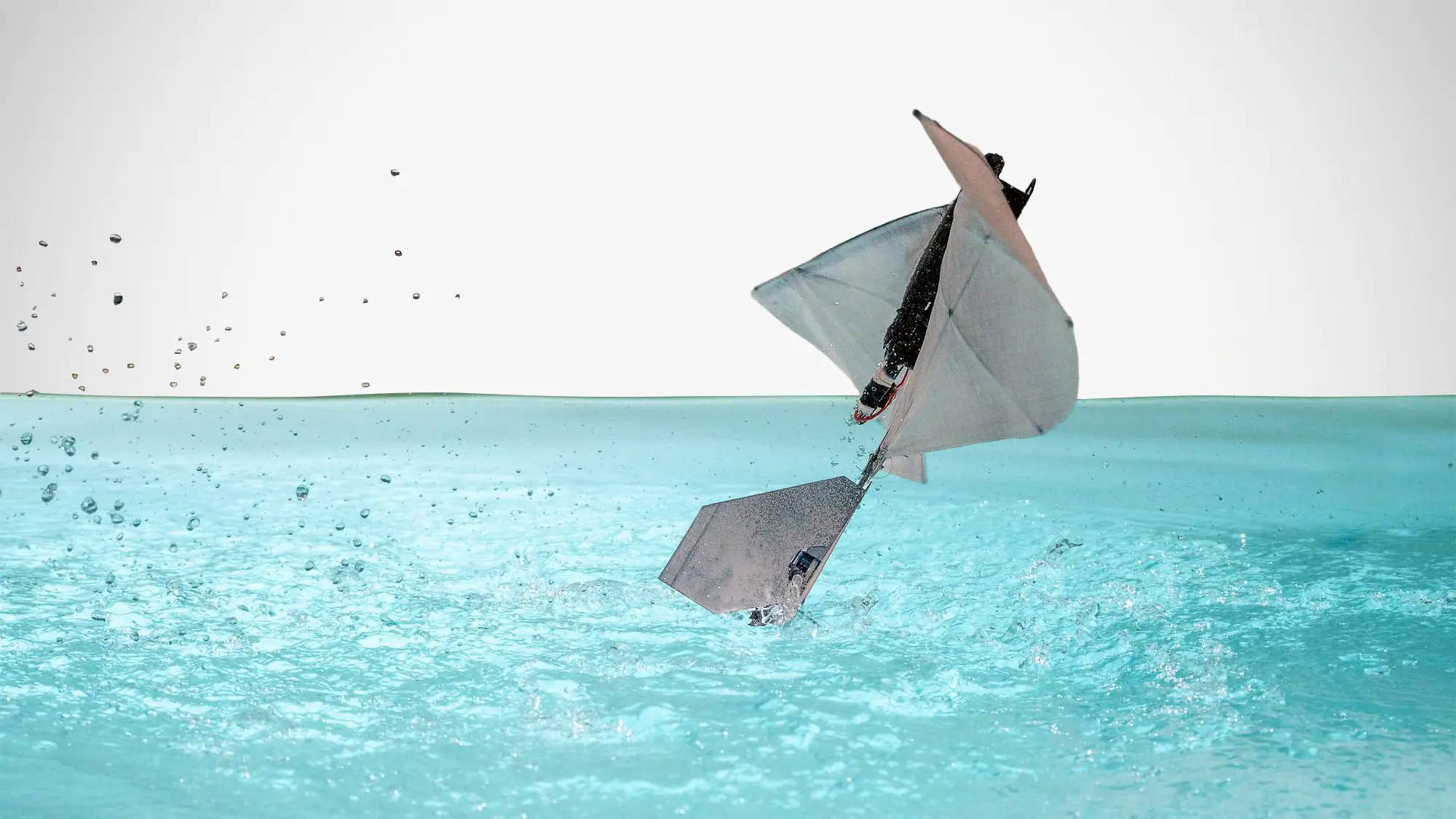
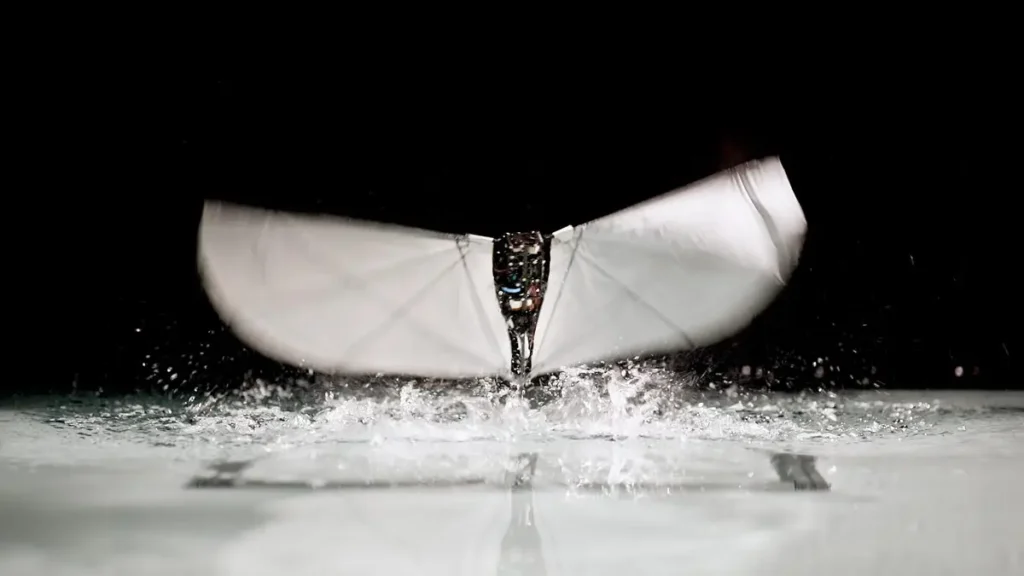
Ever since drones became a thing, scientists have been chasing another dream: making them water-friendly. Not only has that been achieved, but drones capable of operating underwater are now a reality, too. However, engineers at MIT and EPFL in Lausanne, Switzerland, have taken the latter concept, known as an aquatic-aerial vehicle, a step further by turning to nature for inspiration. The result is a puffin-inspired, flapping-wing robot that flies and swims underwater, just like the real bird.
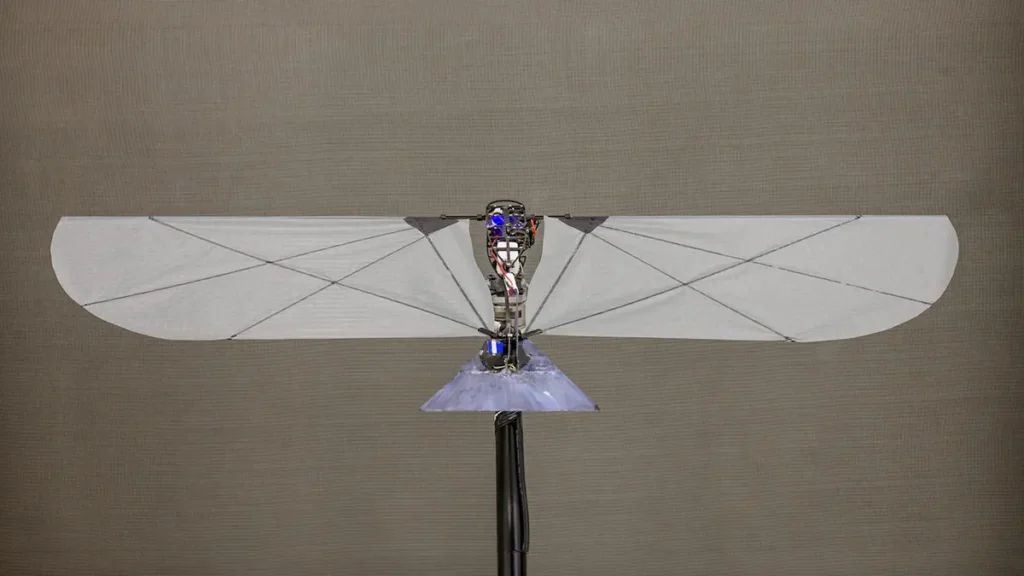
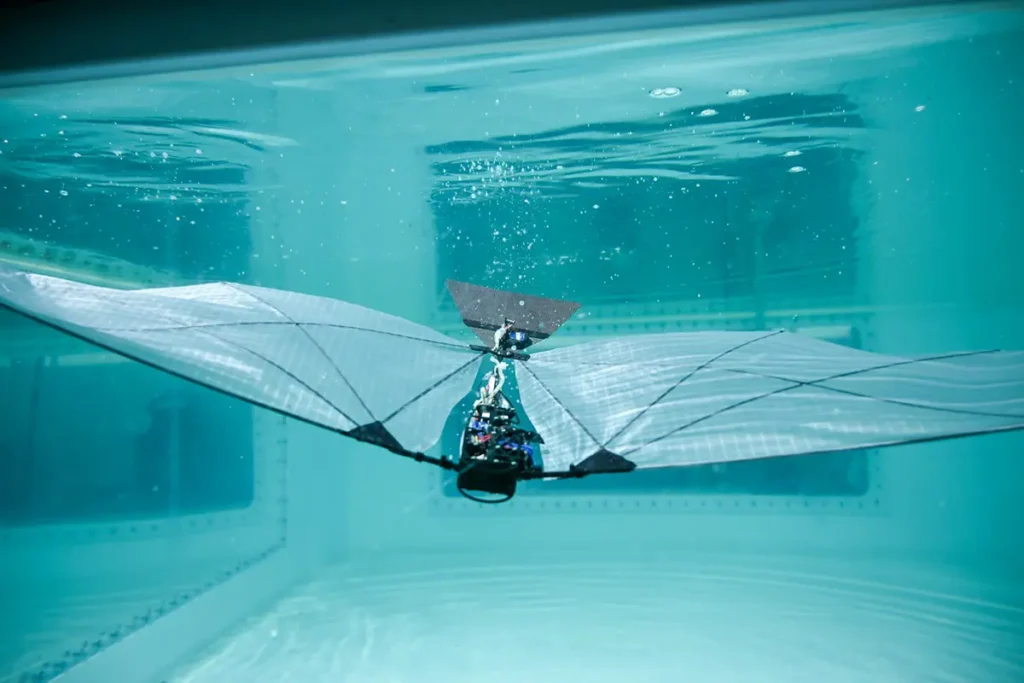
Referred to as a Flapping-Wing Aerial-Aquatic Vehicle (FAAV), this 250 g (8.8 oz) robot is capable of flying through the air, diving underwater, swimming, and launching itself back into flight. And the best part? It doesn’t need propellers or feet to pull off this remarkable feat.
Of course, there’s a reason conventional drones don’t just flap their way underwater. Water is roughly 800 times denser than air, which means wings designed for flight encounter tremendous resistance when submerged. Nature’s solution is to fold the wings. The engineers, however, went with flexible wings that bend under water resistance, reducing the load without complicated folding mechanisms.
The carbon-reinforced wings also feature a water-repelling membrane that sheds water quickly during takeoff. Meanwhile, a waterproof motor drives the flapping mechanism, and a movable tail controls the robot’s pitch. By individually waterproofing the electronics instead of enclosing everything in a bulky watertight housing, the researchers also kept the robot light enough to fly and neutrally buoyant underwater.
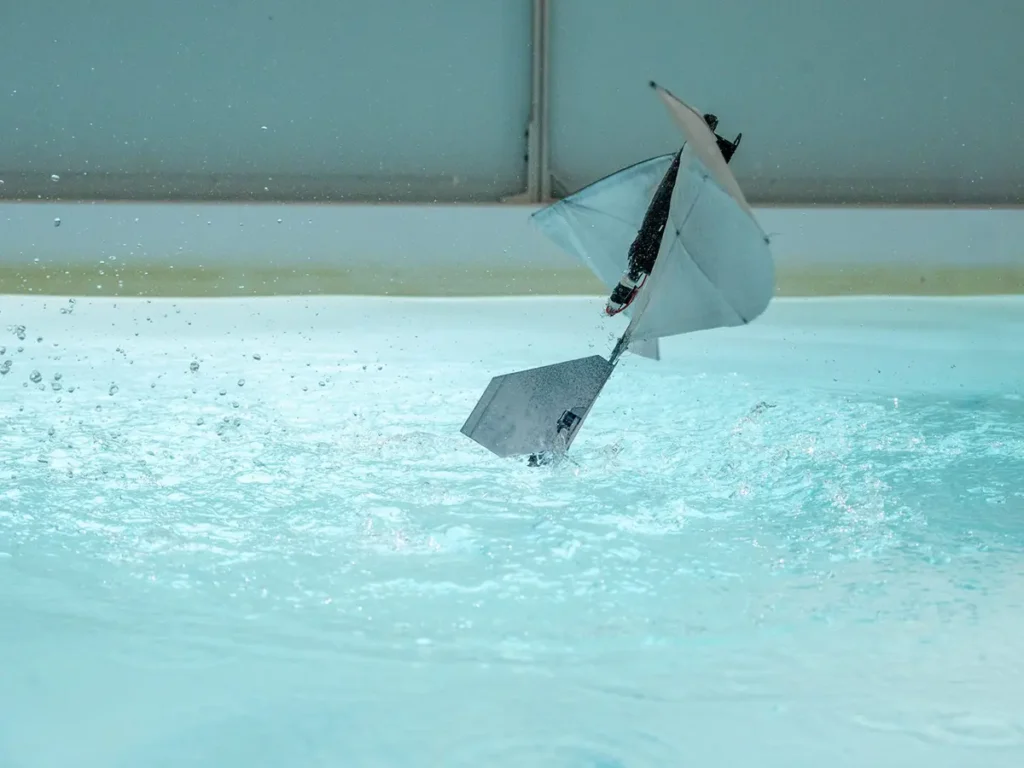
In testing, the FAAV achieved swimming speeds of nearly 1 m/s (3.3 ft/s) and flew at approximately 6.3 m/s (20.7 ft/s). But the real party trick is getting out of the water.
The researchers discovered that an exit angle of around 70° is critical. Get the wing flexibility, tail position, and angle right, and the robot can burst through the surface and resume flying in under a second. No paddling, no launching platform, and certainly no tiny robotic duck feet.
The ultimate goal isn’t to create a robotic puffin just for laughs, though. Researchers envision oceanographers deploying these flying-swimming machines to reach remote locations, collect underwater measurements or samples, and fly home with the findings.
For now, it’s still an experimental research platform, with challenges such as wind, waves, and underwater maneuverability remaining. But the technology has already demonstrated something pretty extraordinary.
Who knew a puffin could be such an excellent robotics consultant? Anyhoo, if you are down, you can learn more about this wonderful creation at aura.mit.edu.
Oh, for those who don’t already know, the concept of a drone or robot transitioning from underwater to flight isn’t new. Rutgers University explored it more than 10 years ago, and so did Johns Hopkins Applied Physics Laboratory about a decade ago. There was even a recreational version.

Images: MIT.